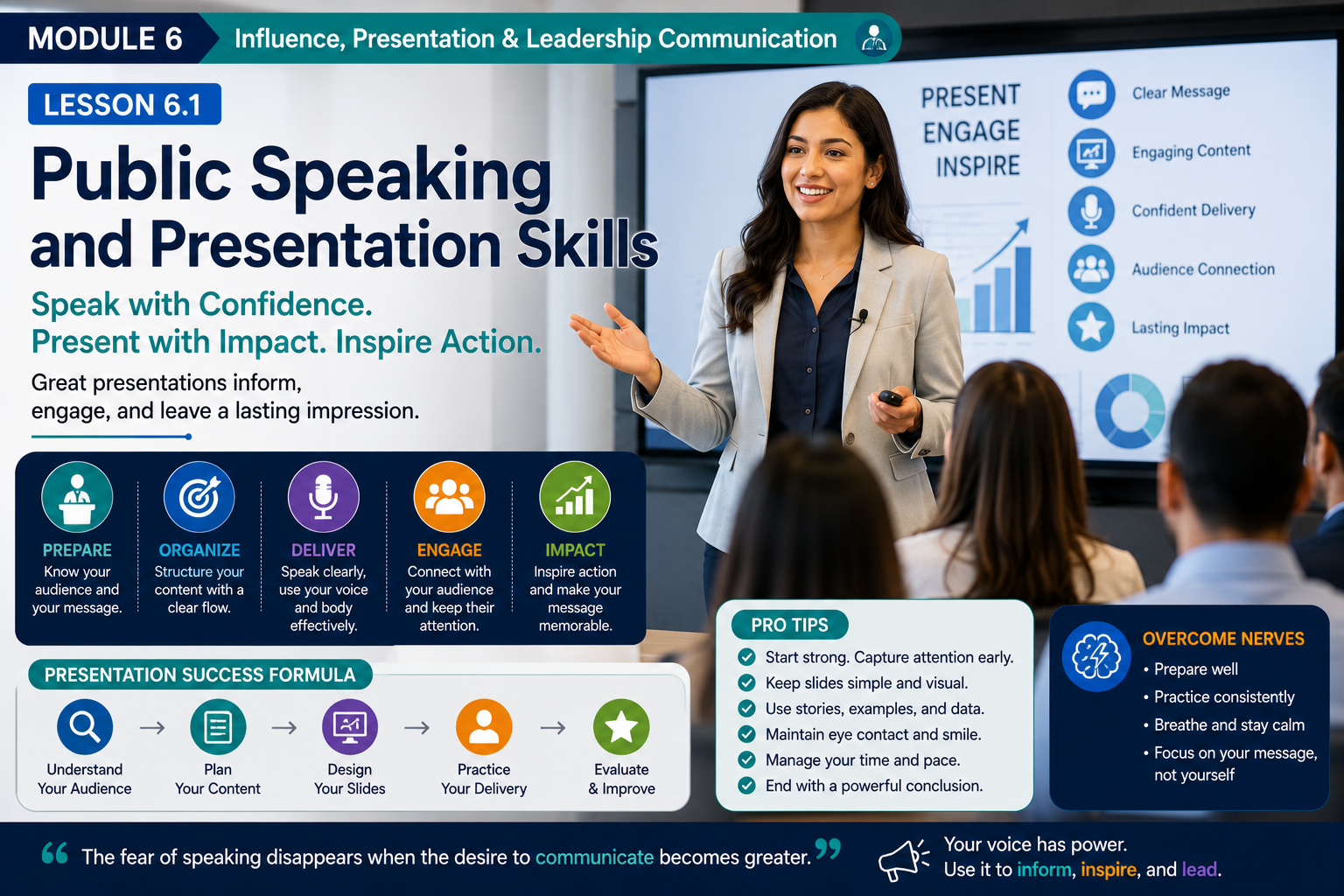
Lesson Description
Public speaking is one of the most valuable communication skills in the modern world. Whether you’re presenting a business proposal, teaching a class, pitching an idea, leading a meeting, speaking at a conference, delivering a webinar, or sharing your expertise online, your ability to communicate confidently can influence careers, businesses, and communities.
Many people fear public speaking, but confidence is not something people are born with—it is a skill developed through preparation, practice, and experience. Today’s professionals also present in hybrid environments, combining in-person presentations with virtual meetings, live streams, and AI-supported visual tools.
This lesson explores the fundamentals of effective public speaking, presentation design, audience engagement, storytelling, and stage confidence. You’ll learn practical techniques used by successful leaders, educators, entrepreneurs, and professional speakers worldwide.
Learning Objectives
By the end of this lesson, you will be able to:
- Understand the fundamentals of effective public speaking.
- Prepare and organize engaging presentations.
- Build confidence before speaking.
- Deliver presentations with clarity and impact.
- Use storytelling to make ideas memorable.
- Engage both in-person and virtual audiences.
- Handle nervousness professionally.
1. Why Public Speaking Matters
Public speaking is no longer limited to conference stages.
Today’s professionals speak in many situations:
- Team meetings
- Client presentations
- Job interviews
- Classroom teaching
- Sales pitches
- Business networking
- Conferences
- Webinars
- Podcasts
- YouTube videos
- Community events
- Online workshops
Strong speaking skills help professionals:
- Build credibility
- Inspire others
- Share knowledge
- Influence decisions
- Lead teams
- Advance their careers
Communication creates opportunities.
2. Understanding Your Audience
Successful presentations begin with understanding your audience.
Before preparing your presentation, ask:
- Who are they?
- What do they already know?
- Why are they attending?
- What problem do they want solved?
- What action should they take afterward?
Great speakers focus on the audience—not themselves.
Audience Analysis
Consider:
Knowledge Level
- Beginners
- Intermediate learners
- Experts
Interests
What topics matter most to them?
Expectations
What value do they expect?
Cultural Diversity
For international audiences:
- Use clear language.
- Avoid unnecessary slang.
- Respect cultural differences.
- Explain technical terms when necessary.
Audience-centered presentations create greater impact.
3. Structuring an Effective Presentation
A clear structure helps audiences understand and remember information.
Use the simple 3-Part Presentation Structure:
Introduction
Capture attention.
Introduce the topic.
Explain why it matters.
Preview the presentation.
Body
Present your main ideas.
Support them with:
- Examples
- Stories
- Data
- Demonstrations
- Visuals
Organize ideas logically.
Conclusion
Summarize key points.
Reinforce the main message.
Provide a clear call to action.
People often remember the ending most clearly.
4. Building Speaking Confidence
Confidence develops through preparation—not perfection.
Professional speakers still experience nervousness.
The difference is that they manage it effectively.
Practical Confidence Strategies
Prepare Thoroughly
Know your material.
Practice multiple times.
Visualize Success
Imagine delivering an engaging presentation.
Positive visualization reduces anxiety.
Focus on Helping
Instead of asking:
“What if I make a mistake?”
Ask:
“How can I help my audience today?”
This mindset reduces self-consciousness.
Accept Imperfection
Minor mistakes happen.
Most audiences notice your confidence more than your mistakes.
5. Using Storytelling
Stories make presentations memorable.
People naturally connect with stories because they create emotion and context.
Why Stories Work
Stories:
- Increase engagement.
- Improve memory.
- Build emotional connection.
- Make complex ideas easier to understand.
Facts inform.
Stories inspire.
Simple Story Structure
Situation
↓
Challenge
↓
Action
↓
Result
↓
Lesson
This framework works across business, education, healthcare, and leadership presentations.
6. Designing Effective Presentation Slides
Slides should support your message—not replace it.
Best Practices
Use:
- Large fonts
- Simple layouts
- High-quality visuals
- Limited text
- Consistent colors
- Clear charts
One idea per slide is usually more effective than overcrowding information.
Avoid
- Long paragraphs
- Tiny text
- Excessive animations
- Distracting backgrounds
- Reading directly from slides
Slides are visual aids—not scripts.
7. Engaging Your Audience
Successful presentations are interactive.
Even large audiences appreciate participation.
Engagement Techniques
Ask questions.
Share stories.
Use real-world examples.
Invite reflection.
Encourage discussion.
Use polls during virtual presentations.
Maintain eye contact.
Audience participation improves learning.
8. Managing Nervousness
Feeling nervous before speaking is normal.
Many experienced speakers still feel nervous before important presentations.
Symptoms
- Fast heartbeat
- Sweaty hands
- Dry mouth
- Rapid breathing
- Forgetfulness
These reactions are natural.
Managing Anxiety
Before speaking:
- Breathe deeply.
- Stretch gently.
- Drink water.
- Practice aloud.
- Arrive early.
- Focus on your audience.
Preparation reduces uncertainty.
9. Handling Questions Professionally
Question-and-answer sessions often create the greatest value.
Best Practices
Listen completely.
Pause before answering.
Repeat the question if necessary.
Answer honestly.
If you don’t know the answer, say:
“That’s an excellent question. I’ll research it and follow up.”
Professional honesty builds credibility.
10. Public Speaking in the AI Era
Modern presenters increasingly use AI.
AI can help:
- Brainstorm ideas.
- Create presentation outlines.
- Improve slide design.
- Generate visuals.
- Summarize research.
- Practice presentations through simulations.
However:
AI cannot replace authentic human connection.
Successful presentations still depend on:
- Confidence
- Empathy
- Storytelling
- Audience awareness
- Passion
Technology enhances communication.
Human presence creates impact.
The S.P.E.A.K. Framework
Use the S.P.E.A.K. Framework when preparing presentations.
S — Study Your Audience
Understand their needs and expectations.
↓
P — Prepare Your Message
Organize information clearly.
↓
E — Engage Through Stories
Make information memorable.
↓
A — Adapt During Delivery
Respond to audience reactions and questions.
↓
K — Keep Improving
Learn from every presentation.
Continuous improvement builds speaking excellence.
Real-World Scenario
Olivia is presenting a new marketing strategy to senior executives.
Instead of reading from crowded slides, she:
- Opens with a short customer success story.
- Explains the business challenge.
- Uses simple visuals.
- Speaks confidently.
- Maintains eye contact.
- Encourages questions.
- Concludes with clear recommendations.
The executives remember both her message and her confidence.
Her presentation succeeds because it focuses on clarity, engagement, and audience value.
Public Speaking Blueprint
Know Your Audience
↓
Prepare Thoroughly
↓
Organize Clearly
↓
Practice Repeatedly
↓
Use Stories and Visuals
↓
Engage the Audience
↓
Handle Questions Professionally
↓
Reflect and Improve
↓
Become a More Confident Speaker
Key Takeaways
- Public speaking is a valuable skill for leadership, career growth, education, and business success.
- Great presentations begin with understanding the audience.
- A clear introduction, organized body, and memorable conclusion improve audience understanding.
- Confidence grows through preparation, practice, and a service-oriented mindset.
- Storytelling makes presentations more engaging and memorable.
- Effective slides support your message with simple visuals and minimal text.
- Audience engagement increases attention and knowledge retention.
- Nervousness is natural and can be managed through preparation and breathing techniques.
- AI is a powerful presentation assistant, but authentic human communication remains essential.
- The S.P.E.A.K. Framework provides a practical roadmap for creating and delivering impactful presentations.
Practice Activity
Prepare a 5-minute presentation on a topic you know well—such as a hobby, professional skill, personal experience, or current industry trend.
Use the S.P.E.A.K. Framework:
- S – Identify your audience.
- P – Organize your presentation into an introduction, body, and conclusion.
- E – Include one short story or real-life example.
- A – Practice adapting your pace and tone as if responding to audience reactions.
- K – Record your presentation and evaluate areas for improvement.
After reviewing your recording, ask yourself:
- Was my message clear and organized?
- Did I sound confident?
- Did I engage the audience with stories or examples?
- What one skill will I improve before my next presentation?
Every presentation is an opportunity to grow. The more you practice, the more naturally confidence, clarity, and influence will develop.