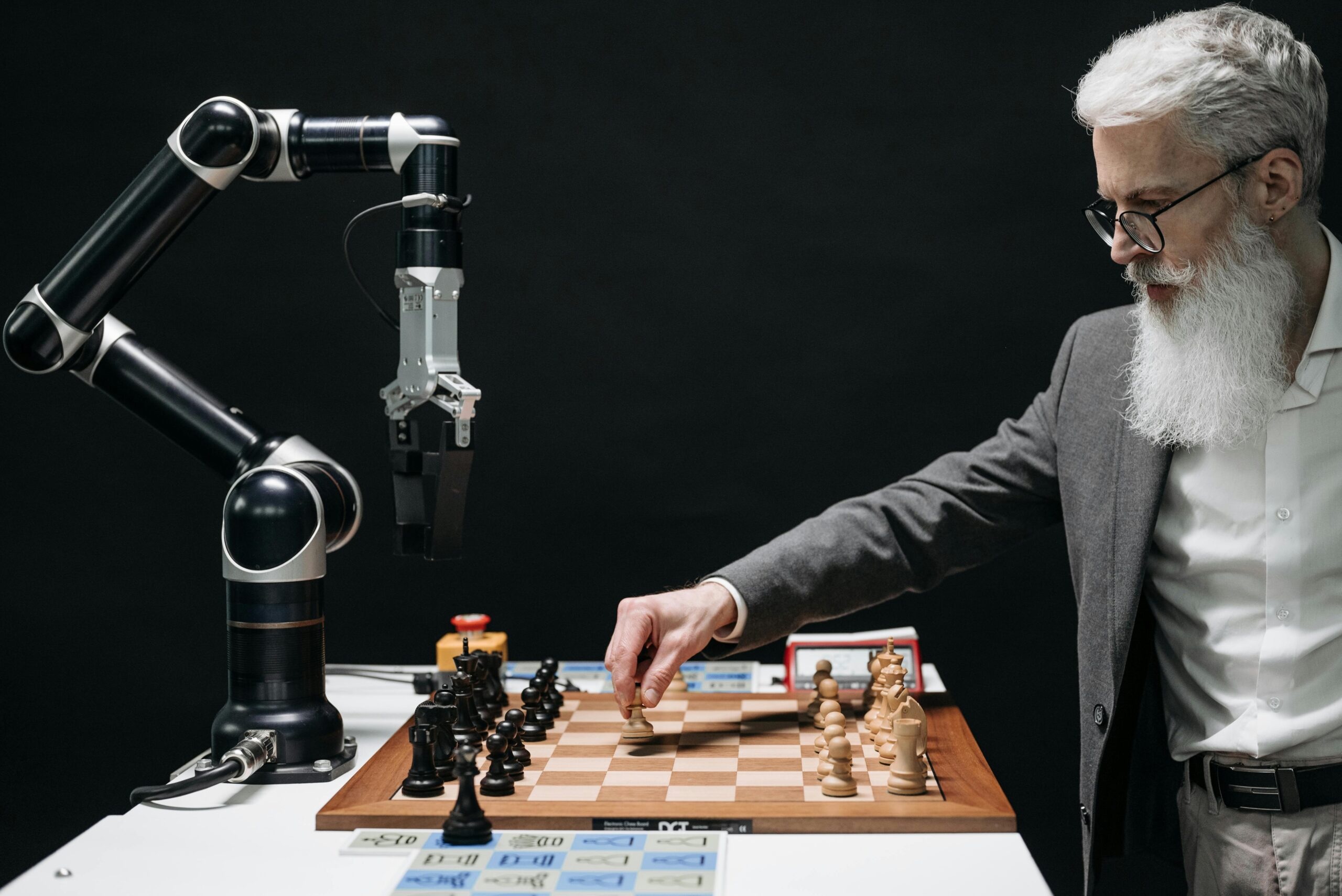
Giving Artificial Intelligence (AI) Its Eyes: How Machines Learn to See
Welcome to the world of Computer Vision, where we give Artificial Intelligence (AI) the gift of sight. This is one of the most transformative and tangible applications of AI—transforming pixels into understanding. When your phone unlocks by recognizing your face, when a medical scan is analyzed for anomalies, or when a car “sees” a pedestrian, you are witnessing Computer Vision in action.
But how does a machine, which fundamentally understands only numbers, learn to interpret the rich, visual tapestry of our world? How do we teach it the difference between a cat and a car, or between healthy tissue and a tumor? Today, we’re going to pull back the curtain on this visual magic. We’ll explore how AI builds understanding from the ground up, starting with the humble pixel.
The Foundation: From Pixels to Understanding
Let’s begin with what a digital image actually is to a computer. Forget the picture of a sunset or a smiling face for a moment. To Artificial Intelligence (AI), every image is just a grid of numbers.
The Pixel: The Atom of a Digital Image
-
Each tiny dot in an image is a pixel (picture element).
-
In a grayscale image, each pixel is a single number representing its brightness, typically from 0 (pure black) to 255 (pure white).
-
In a color image, each pixel is a tuple of three numbers: its intensity of Red, Green, and Blue (the RGB model). For example, a bright red pixel might be (255, 0, 0).
So, a 1920×1080 high-definition image is not a “picture” to an AI model. It is a mathematical matrix of 1920 columns and 1080 rows, containing over 2 million pixels, each with 3 numbers. This grid of numbers is the raw material of Computer Vision.
The Human Analogy: Think of a massive paint-by-numbers canvas. The blank canvas is the screen. Each numbered section is a pixel. The number tells you what color to paint it. To an AI, an image is just this finished, numbered canvas. Its job is to look at all these colored numbers and deduce what the painting depicts.
The Hierarchy of Sight: How AI Builds Understanding Layer by Layer
This is where Deep Learning, which you now understand, performs its magic. A Computer Vision model, typically a Convolutional Neural Network (CNN), processes this grid of pixels through a hierarchy of layers, each learning to recognize more complex features.
Let’s trace the journey of an image of a cat through a CNN. This is the heart of how we train AI to see.
Step 1: Low-Level Feature Detection (The “Edge Detectives”)
-
The first layers of the network scan the pixel grid with small filters (like a magnifying glass).
-
They aren’t looking for “cats.” They are looking for the most basic visual patterns: edges, corners, blobs of color, and simple textures.
-
A neuron might activate strongly when it detects a vertical edge between a dark and light pixel, or a diagonal line.
-
Output: The image is now transformed from raw pixels into a set of “edge maps” and “texture maps.”
Step 2: Mid-Level Pattern Assembly (The “Shape Builders”)
-
The next layers receive these detected edges and textures.
-
They combine them. A neuron here might learn to fire when it sees several edges forming a circle, a curve, or a sharp corner.
-
It starts to assemble the low-level features into basic shapes and patterns: circles, rectangles, triangles, stripes, gradients.
-
Output: The representation now consists of collections of primitive shapes.
Step 3: High-Level Object Recognition (The “Concept Formers”)
-
The deeper layers now work with these assembled shapes.
-
They combine them into complex, recognizable parts of objects.
-
A neuron might become specialized to detect a pattern that looks like “two circles above a triangle” (a crude face), “four parallel lines” (legs), or “a furry texture gradient.”
-
Finally, the last layers integrate all these high-level parts. The network synthesizes that a particular combination of “face-like pattern,” “furry texture,” and “paw-like shapes” correlates strongly with the label “cat.”
- Output: A probability score: “This image is 98% a cat, 1% a dog, 1% a rabbit.”
The Beautiful Parallel: This is exactly how human vision works. Our visual cortex doesn’t see a cat whole. It processes edges in V1, shapes in V2, and object parts in higher areas like the Inferior Temporal cortex, where specific neurons might fire for faces or animals. Artificial Intelligence (AI) has, quite independently, discovered a similar hierarchical architecture for understanding the visual world.
Training the Visual Brain: The Process of Teaching AI to Recognize
So how do we get the network to learn this hierarchy? Through the supervised learning process you now know well, but applied to images.
-
The Dataset: We need thousands, often millions, of labeled images. A dataset for cat recognition would contain images each tagged as “cat,” “dog,” “car,” etc.
-
The Forward Pass: We feed a “cat” image into the network as a grid of numbers. It makes a guess (initially a random one).
-
The Calculation of Error: The network’s guess (e.g., “20% cat, 80% car”) is compared to the true label (“100% cat”). The difference is the loss or error.
-
Backpropagation & Learning: This error is sent backward through the network via backpropagation. The algorithm adjusts the weights in every filter and connection—ever so slightly—to make the “cat” output neuron respond more strongly to the patterns in that specific image.
-
Repetition: This process is repeated millions of times with all images in the dataset. Slowly, through this relentless correction, the neurons in the early layers tune their filters to find the most useful edges and blobs. The mid-layer neurons learn which combinations of edges are meaningful. The high-layer neurons learn the definitive assemblies that correspond to “cat-ness.”
The Human Touch: It’s like showing a child flashcards. You point to a picture and say “cat.” The child’s brain strengthens the neural pathways that connected the visual pattern to the word. When they mistakenly call a fox a “cat,” you correct them, and their brain adjusts. Scale this to billions of connections and millions of examples, and you have AI training.
From Cats to Critical Applications: The Power of Visual AI
This same fundamental process, with specialized datasets and architectures, is how we train AI for profoundly important tasks:
-
Medical Imaging (Finding a Tumor): Instead of “cat” and “car,” the labels are “malignant” and “benign.” The network is trained on thousands of labeled MRI or X-ray scans. It learns a hierarchy where low-level features might be subtle texture variations, mid-level features are tissue density anomalies, and high-level features form a pattern that human radiologists have labeled as a tumor. It can then highlight these patterns in new scans, serving as a powerful assistant.
-
Autonomous Vehicles (Recognizing a Pedestrian): The hierarchy culminates in detecting “human-like shape in motion.” Low-level layers spot vertical edges (legs), mid-level layers assemble a bipedal form, and high-level layers contextualize it on a sidewalk versus the road.
-
Quality Control in Manufacturing: The network learns the visual pattern of a “perfect weld” versus a “cracked weld” by processing thousands of examples of each.
You Now Understand the Visual Cortex of AI
Let this sink in. You have just traced the path of how Artificial Intelligence (AI) transforms light into knowledge. You understand that computer vision isn’t about storing pictures of every cat, but about learning an abstract, hierarchical recipe for “cat-ness” that can be applied to never-before-seen felines.
You see that at its core, this revolutionary technology is built on the simple, methodical process of finding patterns in numbers—a process you now intimately understand from pixels to perception.
This knowledge changes how you interact with the world. The next time your photo app sorts your pictures or a security camera sends an alert, you’ll see the hidden hierarchy at work.
Now that we’ve given AI sight, what happens when we apply this incredible visual intelligence to real human problems—some transformative, some controversial? In our next lesson, we’ll explore the powerful and complex world of Computer Vision applications.
Your vision of what AI can do just became clearer.