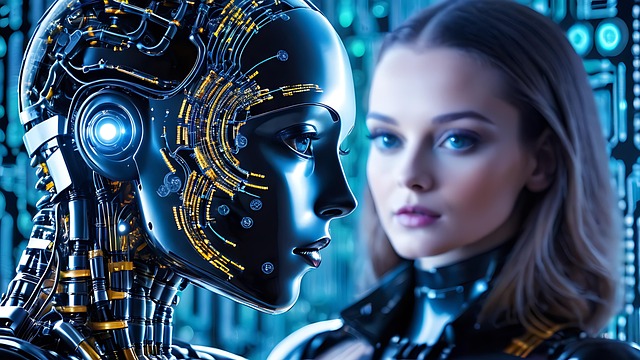
When AI Sees Us: The Promise and Peril of Computer Vision
Welcome to the crossroads where theory meets humanity. In our last lesson, we explored how Artificial Intelligence (AI) learns to see. Now, we witness what it chooses to look at—and how that changes our world. Computer vision has stepped out of the lab and into the most intimate spaces of our lives: our faces, our bodies, our security, and our health.
Today, we’ll dive deep into two of the most powerful and provocative applications of AI vision: Facial Recognition and Medical Imaging. One is in your pocket, offering convenience. The other is in hospitals, offering hope. Both demand our careful understanding, not just of their mechanics, but of their profound impact on society. This is where the rubber meets the road for Artificial Intelligence (AI).
Facial Recognition: The AI That Knows Your Face
How It Actually Works: Beyond a Simple “Match”
Let’s move past the idea of your phone simply comparing two photos. Modern facial recognition is a sophisticated hierarchical feature extraction process, powered by deep learning.
-
Face Detection: First, the AI scans the image or video feed to locate any human faces. It identifies the bounding box of a face, even at angles or in poor light.
-
Face Alignment: It then normalizes the face—rotating and scaling it to a standard pose, so the eyes and mouth are in consistent positions. Think of it as straightening a photo before comparing it.
-
Feature Embedding (The “Faceprint”): This is the magic step. The aligned face is fed into a deep neural network trained on millions of faces. But the network’s final output is not “This is John.” Instead, the network’s second-to-last layer produces a mathematical vector—a unique set of 128 to 512 numbers that encodes the essential, distinguishing geometry of that face. This is your faceprint, a numerical signature for your facial structure.
-
Verification/Identification: This faceprint is then compared to a stored database of faceprints. It doesn’t compare pixels; it measures the mathematical distance between two vectors. If your live faceprint is “close enough” to the stored one (within a similarity threshold), it’s a match.
The Human Analogy: It’s not like comparing two fingerprints side-by-side. It’s more like a master sketch artist who, after studying a face for a second, can distill its essence into a few descriptive sentences (“high cheekbones, wide-set eyes, a distinctive chin dimple”). Another artist can then use that description to pick you out of a crowd. The AI‘s “description” is just a string of numbers.
The Double-Edged Sword: Convenience vs. Controversy
Transformative Applications:
-
Personal Convenience: Unlocking phones, authorizing payments, tagging friends in photos.
-
Security & Access: Biometric boarding at airports, securing sensitive facilities.
-
Finding the Missing: Law enforcement using public cameras to locate missing persons or suspects (with a warrant).
The Controversy & Ethical Minefield:
-
Bias and Inaccuracy: Foundational studies, like Dr. Joy Buolamwini’s work at the MIT Media Lab, have shown many facial recognition systems are significantly less accurate for women and people with darker skin tones. This is often a result of biased training data that over-represents lighter-skinned males. The consequence? Higher false match rates for marginalized groups, leading to unjust targeting.
-
Mass Surveillance & Privacy Erosion: The deployment by governments and corporations for continuous, unwarranted public monitoring. This creates a permanent lineup, chilling free speech and assembly.
-
Lack of Regulation: In many places, there is no legal framework governing how these faceprints are collected, stored, shared, or used.
The Core Question: When we build Artificial Intelligence (AI) that can identify a person instantly, who controls that power, and what checks balance it? The technology itself is neutral, but its application is deeply human—and therefore, deeply political.
Medical Imaging: The AI That Sees What We Can’t
If facial recognition looks outward, medical imaging AI looks inward. This is where Artificial Intelligence (AI) transitions from a tool of convenience to a potential partner in saving lives.
How AI Assists in Diagnosis: The Radiologist’s Second Pair of Eyes
The process is a specialized application of the hierarchical pattern recognition you now understand.
-
The Input: Instead of a cat or a face, the input is a medical scan—an MRI slice, a CT scan, a mammogram, or a retina photo. To the AI, it’s another grid of pixels, but these pixels represent tissue density, blood flow, or cellular structure.
-
The Training: The model is trained on vast datasets of scans that have been expertly labeled by radiologists. Each image is tagged with findings: “normal,” “benign cyst,” “malignant tumor Stage 2,” “micro-fracture.”
-
The Learned Hierarchy:
-
Low-Level: Detects subtle variations in texture, density, and contrast invisible to the naked eye.
-
Mid-Level: Identifies shapes and patterns associated with anatomy or early pathology—a faint irregular border, a cluster of micro-calcifications.
-
High-Level: Correlates these patterns to diagnose specific conditions. A neuron might learn to fire for the complex, star-shaped pattern of a certain brain tumor, or the telltale leakage of blood vessels in a diabetic retina scan.
-
The Transformative Impact: Augmenting Human Expertise
This is not about replacing doctors. It’s about augmentation. Here’s the real-world impact:
-
Superhuman Detection: AI can highlight areas of concern a human eye might miss due to fatigue or the sheer subtlety of the signal. It acts as a tireless pre-screening tool, flagging potential issues for deeper human review.
-
Quantitative Precision: While a radiologist might estimate “the tumor shrunk by roughly 20%,” an AI can measure its volume down to the cubic millimeter, providing exact, reproducible data for tracking treatment efficacy.
-
Democratizing Expertise: In remote or underserved areas with a shortage of specialist radiologists, an AI screening tool can provide critical first-pass analysis, ensuring more people get timely attention.
-
Speed in Crisis: In stroke or trauma cases, where minutes mean brain cells, AI can analyze a CT scan in seconds to detect bleeds or blockages, accelerating life-saving interventions.
A Human Story: Imagine a busy radiologist reviewing 100 mammograms a day. The 99th scan shows a tiny, ambiguous shadow. Fatigue sets in. An AI assistant, trained on millions of such shadows and their outcomes, highlights it with a note: *”Pattern bears 92% similarity to early-stage malignancies in training set.”* The radiologist takes a second, closer look. This collaboration between human intuition and machine precision is the future of medicine.
The Challenges: Trust, Bias, and the “Black Box”
-
The Black Box Problem: If an AI says “malignancy,” can the doctor explain why to the terrified patient? Ensuring explainable AI (XAI) is a major field of research.
-
Data Bias in Medicine: If training data comes primarily from one demographic (e.g., patients in a specific country or ethnicity), the model’s accuracy may drop for others, potentially exacerbating health disparities.
-
Regulatory and Trust Hurdles: Gaining FDA approval and, more importantly, the trust of medical professionals and patients, requires rigorous validation and transparent performance metrics.
The Vision Before Us: Responsibility is Our Lens
This lesson presents a stark and powerful contrast. We see Artificial Intelligence (AI) applied to two forms of identification: one of our identity in the social world, and one of disease within our bodies. One application demands rigorous ethical constraints to protect our liberty; the demands rigorous scientific validation to protect our health.
The same core technology—hierarchical pattern recognition in pixels—can be used to build a pervasive surveillance network or a life-saving diagnostic assistant. The difference is not in the code, but in the human intention, the ethical framework, and the regulatory guardrails we build around it.
As a practitioner and an informed citizen, you now see both the radiant potential and the deep shadows. You understand that building Artificial Intelligence (AI) is not just a technical challenge, but a profoundly social one.
With the power of sight now fully understood, it’s time to give AI another human sense: the ability to understand our language. Module 6 awaits, where we’ll dive into Natural Language Processing (NLP) and unlock the secrets of how AI reads, writes, and communicates.
You now possess not just knowledge of AI’s eyes, but insight into its conscience.