Lesson Overview
Communication is more than a skill—it is a mindset. While techniques such as public speaking, active listening, and writing can be learned, lasting success in communication depends on how we think, learn, respond, and grow.
The world’s best communicators are not necessarily those who speak the most. They are individuals who continuously learn, remain emotionally aware, stay curious, adapt to different situations, and seek to understand before being understood.
In today’s rapidly changing world—where artificial intelligence, remote work, multicultural teams, and digital collaboration are becoming the norm—the right communication mindset is one of the most valuable professional assets.
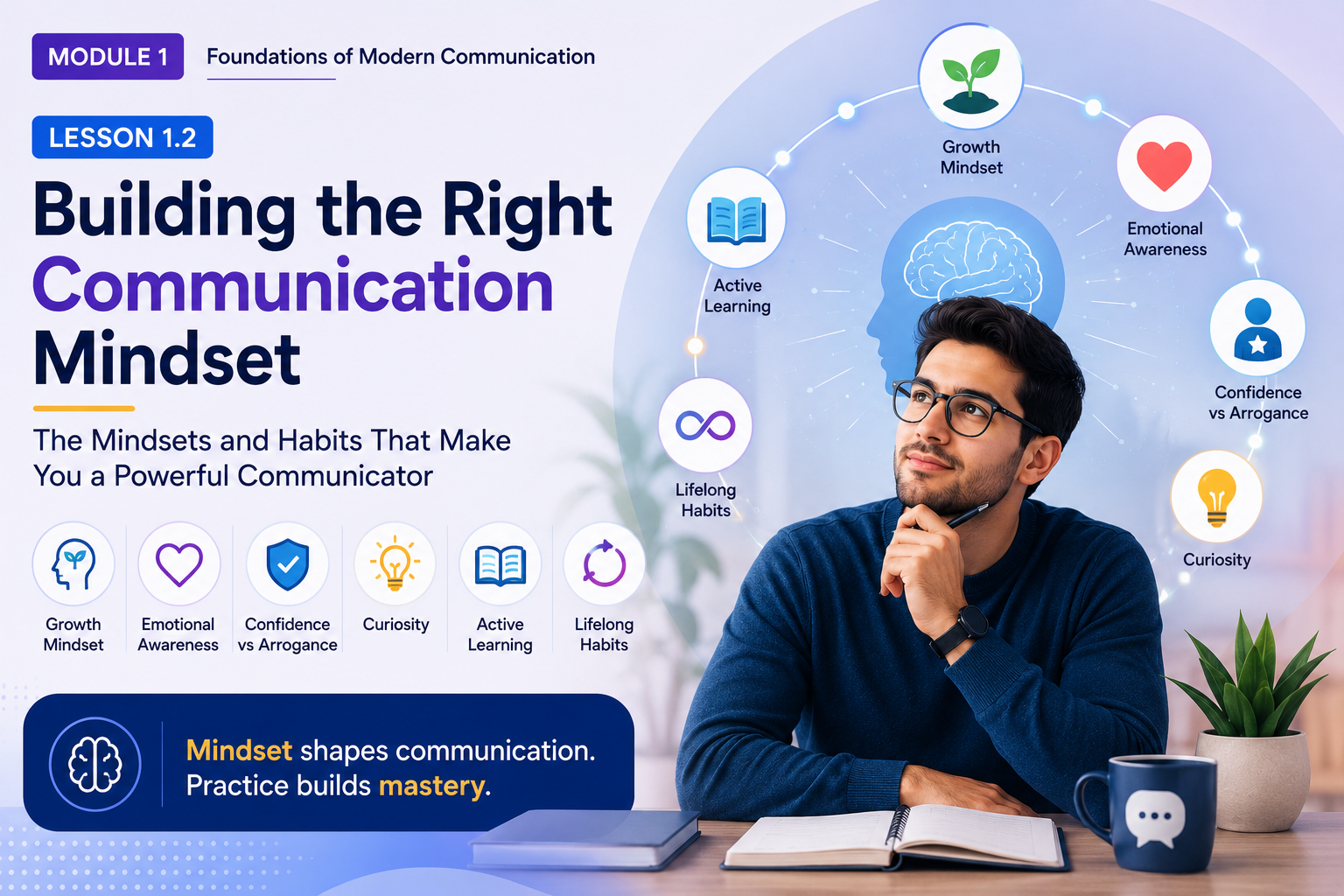
This lesson explores six essential mindset principles that form the foundation of effective communication throughout life.
Learning Objectives
By the end of this lesson, you will be able to:
- Understand the importance of a communication mindset.
- Develop a growth mindset toward communication skills.
- Improve emotional awareness during conversations.
- Distinguish confidence from arrogance.
- Use curiosity to become a better communicator.
- Adopt active learning habits for continuous improvement.
- Build lifelong communication practices for personal and professional success.
1. What Is a Communication Mindset?
A communication mindset is the set of beliefs, attitudes, and habits that influence how you communicate with others.
It affects:
- How you listen
- How you speak
- How you react to feedback
- How you handle disagreements
- How you solve misunderstandings
- How you build relationships
Two people may have the same communication knowledge, yet achieve very different results because of their mindset.
Communication is not about trying to appear perfect. It is about being open to learning, adapting, and improving.
2. Developing a Growth Mindset
What Is a Growth Mindset?
A growth mindset is the belief that abilities and skills can improve through learning, practice, and feedback.
People with a fixed mindset often think:
- “I’m just not a good speaker.”
- “I’m shy by nature.”
- “I’m bad at presentations.”
People with a growth mindset think:
- “I can become a better communicator.”
- “Every conversation is an opportunity to improve.”
- “Mistakes help me learn.”
Communication is not a talent reserved for a few people—it is a skill that develops over time.
Characteristics of a Growth Mindset
- Welcomes constructive feedback.
- Learns from mistakes.
- Practices consistently.
- Tries new communication techniques.
- Accepts challenges.
- Focuses on long-term improvement.
Practical Example
Imagine giving your first presentation.
Instead of thinking:
“I failed.”
Ask yourself:
- What went well?
- What can I improve next time?
- Which skill should I practice?
This simple shift transforms every experience into a learning opportunity.
3. Emotional Awareness
Communication is deeply connected to emotions.
Before understanding others, we must first understand ourselves.
What Is Emotional Awareness?
Emotional awareness is the ability to recognize, understand, and manage your emotions while also recognizing the emotions of others.
Why It Matters
Emotions influence:
- Tone of voice
- Word choice
- Listening ability
- Decision-making
- Conflict resolution
When emotions become overwhelming, communication often becomes less effective.
Examples
Instead of replying immediately when angry:
Pause.
Take a deep breath.
Think before responding.
A calm response usually produces better outcomes than an emotional reaction.
Building Emotional Awareness
Practice asking yourself:
- What am I feeling?
- Why do I feel this way?
- How might the other person feel?
- What response would improve this conversation?
These questions encourage thoughtful rather than impulsive communication.
4. Confidence vs. Arrogance
Many people confuse confidence with arrogance.
The two are very different.
Confidence
Confident communicators:
- Speak clearly.
- Respect others.
- Admit mistakes.
- Welcome different opinions.
- Listen carefully.
- Continue learning.
Confidence creates trust.
Arrogance
Arrogant communicators often:
- Interrupt others.
- Believe they already know everything.
- Ignore feedback.
- Dominate conversations.
- Dismiss alternative viewpoints.
Arrogance damages relationships and reduces collaboration.
Healthy Confidence
Healthy confidence means:
“I believe in my abilities, while recognizing that I can still learn from others.”
This balance makes communication both effective and respectful.
5. The Power of Curiosity
Curiosity is one of the most underrated communication skills.
Curious people ask better questions.
Better questions lead to better conversations.
Why Curiosity Matters
Curiosity helps you:
- Understand different perspectives.
- Avoid assumptions.
- Build stronger relationships.
- Solve problems more effectively.
- Learn continuously.
Curious Communicators
Instead of saying:
“I already know.”
Ask:
- Can you explain that further?
- What led you to that conclusion?
- How did you solve this problem?
- What would you recommend?
These questions deepen understanding and encourage meaningful dialogue.
Curiosity in Global Communication
In multicultural workplaces, curiosity is especially important.
Rather than judging differences, curious communicators seek to understand them.
This creates more inclusive and respectful conversations.
6. Active Learning
Communication improves through practice, not just theory.
Active learning means intentionally improving through experience.
Active Learners
They:
- Observe skilled communicators.
- Read books.
- Take courses.
- Practice conversations.
- Reflect on interactions.
- Request feedback.
- Experiment with new techniques.
Every conversation becomes a learning opportunity.
Modern Learning Resources
Today’s communicators have access to:
- Online courses
- Podcasts
- TED-style talks
- Professional webinars
- AI-powered learning tools
- Communication simulations
- Virtual workshops
- Peer learning communities
Learning has become more accessible than ever before.
7. Developing Lifelong Communication Habits
Communication is not mastered in a single course.
It is a lifelong journey.
The world’s most respected leaders continue improving their communication throughout their careers.
Daily Habits for Better Communication
Read Every Day
Reading improves:
- Vocabulary
- Critical thinking
- Writing ability
- Knowledge
Listen More Than You Speak
Practice listening without interrupting.
Understand before responding.
Ask Better Questions
Replace closed questions with thoughtful open-ended questions.
Instead of:
“Did you like it?”
Ask:
“What did you find most valuable?”
Reflect on Conversations
After important conversations, ask yourself:
- What went well?
- What could improve?
- What did I learn?
Reflection accelerates improvement.
Seek Feedback
Ask trusted colleagues, mentors, or friends:
“How can I communicate more effectively?”
Constructive feedback reveals blind spots that self-reflection may miss.
Practice Public Speaking
Join opportunities to speak:
- Team meetings
- Workshops
- Community groups
- Online presentations
Confidence develops through repeated practice.
Continue Learning
The communication landscape changes constantly.
New technologies, AI tools, digital platforms, and global collaboration require continuous learning.
Lifelong learners remain adaptable and relevant.
Communication Mindset in the AI Era
Artificial Intelligence can improve productivity, but it cannot replace the human qualities that create meaningful communication.
Successful professionals combine technology with:
- Empathy
- Ethical judgment
- Critical thinking
- Creativity
- Cultural awareness
- Emotional intelligence
These human strengths will remain valuable regardless of technological advances.
Real-World Scenario
Imagine two new employees joining the same international company.
Employee A
- Avoids feedback.
- Believes communication skills cannot improve.
- Speaks more than listens.
- Becomes defensive during discussions.
Employee B
- Welcomes constructive feedback.
- Reflects after meetings.
- Asks thoughtful questions.
- Learns from experienced colleagues.
- Practices communication regularly.
After one year, Employee B is more likely to build stronger relationships, collaborate effectively, and take on leadership responsibilities—not because of natural talent, but because of a growth-oriented communication mindset.
Communication Mindset Blueprint
Great communication begins with the right mindset:
Growth Mindset
→ Believe skills can improve.
↓
Emotional Awareness
→ Understand yourself and others.
↓
Healthy Confidence
→ Stay confident without becoming arrogant.
↓
Curiosity
→ Ask questions and explore new perspectives.
↓
Active Learning
→ Learn continuously through practice and feedback.
↓
Lifelong Habits
→ Build consistent routines for ongoing improvement.
↓
Communication Excellence
Key Takeaways
- Communication success starts with mindset, not just technique.
- A growth mindset transforms mistakes into learning opportunities.
- Emotional awareness improves self-control, empathy, and relationship-building.
- Confidence earns trust, while arrogance weakens communication.
- Curiosity leads to deeper understanding and more meaningful conversations.
- Active learning helps you improve through reflection, feedback, and practice.
- Lifelong communication habits ensure continuous personal and professional growth.
- In an AI-powered world, human qualities such as empathy, curiosity, adaptability, and ethical judgment make communication truly impactful.
Reflection Activity
Take a few minutes to evaluate your current communication mindset.
Consider these questions:
- Do I believe my communication skills can improve?
- How do I usually respond to feedback?
- Am I more focused on speaking or understanding?
- When was the last time I intentionally practiced communication?
- Which mindset area—growth, emotional awareness, confidence, curiosity, active learning, or lifelong habits—needs the most improvement?
Write your answers in a learning journal and identify one communication habit you will practice consistently over the next seven days. Small, deliberate improvements repeated over time lead to lasting communication mastery.