Lesson Description
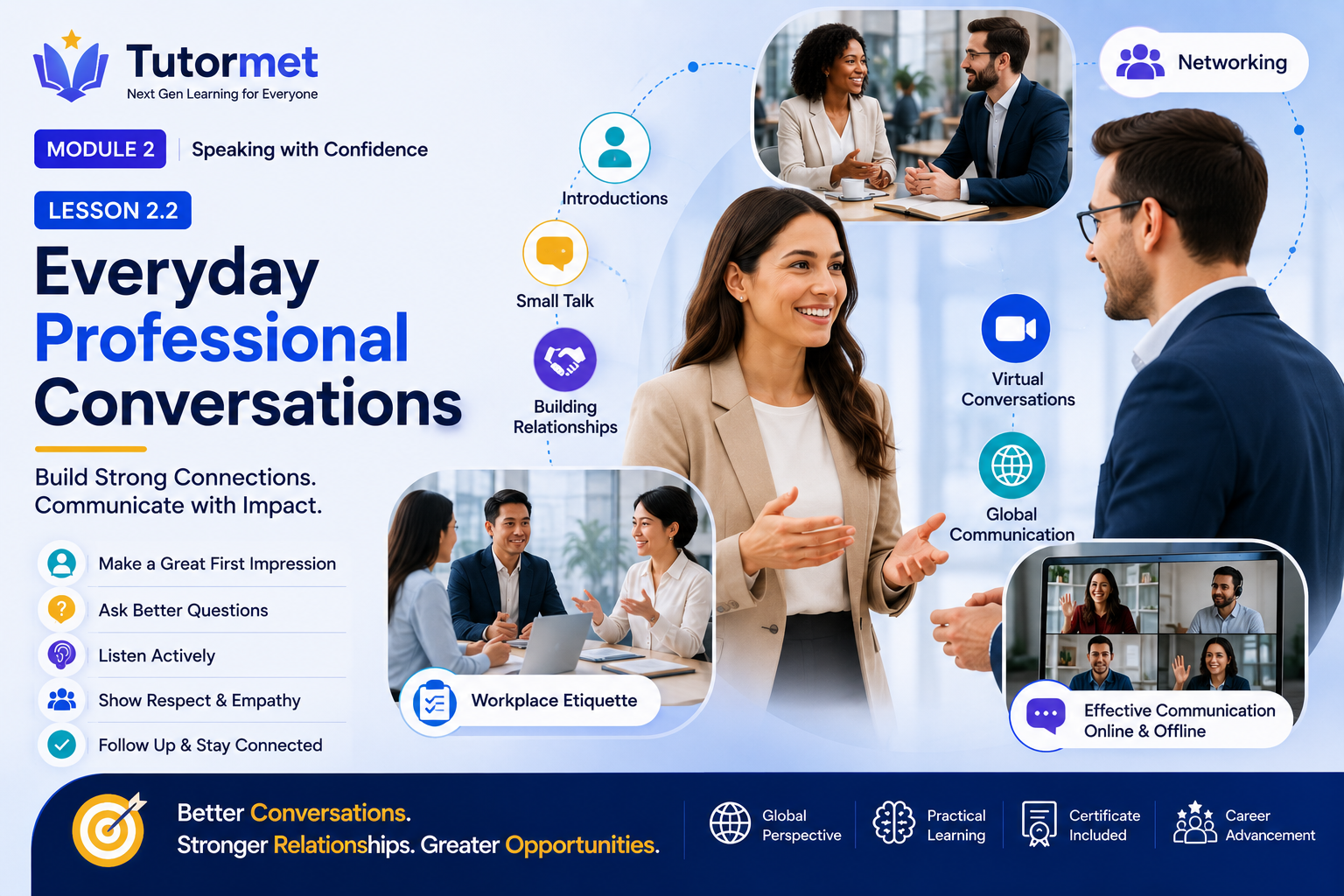
Professional success depends not only on what you know, but also on how effectively you communicate with others every day. Whether you’re introducing yourself at a networking event, participating in meetings, attending job interviews, speaking with clients, collaborating with colleagues, or communicating virtually, your conversation skills shape your professional reputation.
Every interaction is an opportunity to build trust, create meaningful relationships, and leave a positive impression.
This lesson explores practical communication techniques that help you navigate everyday professional conversations with confidence, authenticity, and professionalism in today’s global workplace.
Learning Objectives
By the end of this lesson, you will be able to:
- Introduce yourself confidently in professional settings.
- Master the art of small talk.
- Build meaningful professional relationships through networking.
- Follow modern workplace communication etiquette.
- Communicate effectively in virtual meetings.
- Create positive first impressions.
- Adapt your communication style for different audiences.
1. The Importance of Everyday Professional Conversations
Communication is not limited to presentations or public speaking.
In reality, most professional communication happens during everyday interactions.
Examples include:
- Greeting colleagues
- Team discussions
- Job interviews
- Coffee conversations
- Client meetings
- Networking events
- Video conferences
- Phone calls
- Workplace chats
- Online collaboration
These seemingly ordinary conversations often influence the following:
- Career opportunities
- Promotions
- Business partnerships
- Customer relationships
- Team performance
- Professional reputation
Small conversations often lead to big opportunities.
2. Creating a Strong First Impression
Research consistently shows that people begin forming impressions within seconds of meeting someone.
Although first impressions can change over time, they often influence future interactions.
Elements of a Strong First Impression
Appearance
Dress appropriately for the situation.
Professional appearance demonstrates respect for yourself and others.
Body Language
Maintain:
- Good posture
- Natural smile
- Comfortable eye contact
- Open gestures
- Confident handshake (where culturally appropriate)
Voice
Speak:
- Clearly
- Calmly
- Politely
- At a moderate pace
Attitude
Show:
- Respect
- Curiosity
- Positivity
- Confidence
- Professionalism
People remember how you make them feel more than the exact words you use.
3. Introducing Yourself Effectively
A professional introduction should be brief, clear, and memorable.
A simple introduction framework is the following:
Name → Role → What You Do → Purpose
Example:
“Hello, I’m Sarah Williams. I’m a Product Designer at BrightTech, where I focus on creating user-friendly digital experiences. It’s great to meet you.”
Tips for Better Introductions
- Smile naturally.
- Speak slowly.
- Make eye contact.
- Avoid memorized speeches.
- Show genuine interest in the other person.
Remember:
A conversation is a two-way interaction—not a personal advertisement.
4. Mastering Small Talk
Many people underestimate small talk.
In reality, it is often the first step toward building meaningful professional relationships.
Small talk creates comfort before discussing important topics.
Suitable Small Talk Topics
- Travel
- Weather
- Industry events
- Books
- Technology
- Conferences
- Learning
- Hobbies
- Local culture
- Food (when appropriate)
Topics to Avoid Initially
Unless appropriate for the setting:
- Politics
- Religion
- Personal finances
- Sensitive personal issues
- Offensive humor
Professional conversations should remain respectful and inclusive.
How to Keep Small Talk Going
Ask open-ended questions.
Examples:
- What inspired you to enter this field?
- What projects are you currently working on?
- What do you enjoy most about your work?
- What skills are you currently learning?
People generally appreciate genuine interest.
5. Building Professional Networking Skills
Networking is not about collecting business cards.
It is about building long-term professional relationships based on trust and mutual value.
Effective Networking Principles
Be Curious
Ask thoughtful questions.
Listen actively.
Avoid making the conversation entirely about yourself.
Offer Value
Think beyond.
“What can I gain?”
Instead, ask:
“How can I help?”
Professional relationships grow through mutual support.
Follow Up
After meeting someone:
- Send a thank-you message.
- Connect on LinkedIn.
- Share useful resources.
- Stay in touch occasionally.
Networking continues after the first conversation.
6. Workplace Communication Etiquette
Professional etiquette creates respectful and productive workplaces.
In-Person Etiquette
- Arrive on time.
- Listen without interrupting.
- Respect different opinions.
- Use polite language.
- Stay focused during conversations.
- Avoid unnecessary phone use.
Professionalism is demonstrated through consistent behavior.
Meeting Etiquette
Before the meeting:
- Prepare.
- Review the agenda.
During the meeting:
- Participate actively.
- Listen carefully.
- Speak concisely.
- Stay on topic.
After the meeting:
- Confirm action items.
- Follow through on commitments.
Reliability builds credibility.
Email and Messaging Etiquette
Modern workplaces rely heavily on written communication.
Best practices:
- Use clear subject lines.
- Keep messages concise.
- Be respectful.
- Proofread before sending.
- Respond within a reasonable timeframe.
Digital communication reflects your professionalism.
7. Virtual Conversations
Remote and hybrid work have transformed professional communication.
Virtual communication requires additional skills beyond traditional conversations.
Preparing for Virtual Meetings
Before joining:
- Test your microphone.
- Check your internet connection.
- Ensure good lighting.
- Minimize background noise.
- Choose a professional background.
Preparation reduces unnecessary distractions.
During Virtual Meetings
- Join on time.
- Maintain eye contact by looking at the camera.
- Mute your microphone when not speaking.
- Avoid multitasking.
- Use clear verbal communication.
- Participate respectfully.
Virtual presence is part of your professional image.
Camera Etiquette
When possible:
- Position your camera at eye level.
- Sit upright.
- Dress professionally.
- Maintain a natural expression.
Good virtual presence improves engagement.
8. Communicating with International Teams
Today’s professionals often collaborate with colleagues across different countries and cultures.
Successful communication requires cultural intelligence.
Best Practices
Speak clearly.
Avoid slang and idioms that may confuse non-native English speakers.
Be patient.
Respect cultural differences.
Allow others time to respond.
Confirm understanding when discussing important information.
Global communication values clarity over complexity.
9. Active Participation in Conversations
Confident communicators contribute without dominating.
Balance is essential.
Listen
Understand before responding.
Think
Organize your thoughts.
Speak
Share ideas clearly and respectfully.
Invite Others
Encourage participation by asking:
“What are your thoughts?”
Inclusive conversations produce better outcomes.
10. Common Mistakes to Avoid
Avoid these common communication habits:
- Interrupting others
- Speaking too much
- Not listening
- Checking your phone constantly
- Using excessive jargon
- Talking over colleagues
- Avoiding eye contact
- Dominating meetings
- Ignoring cultural differences
- Forgetting to follow up
Small improvements create significant professional advantages.
Real-World Scenario
Emma attends an international technology conference.
Instead of immediately promoting herself, she introduces herself confidently, asks thoughtful questions, listens carefully, and shows genuine curiosity about other professionals’ work.
After the event, she connects with several attendees on LinkedIn, thanks them for the conversation, and shares a useful article related to their discussion.
A few months later, one of those connections recommends her for an exciting international project.
The opportunity was created not by a sales pitch, but by authentic professional communication and relationship-building.
Everyday Professional Conversation Framework
Successful conversations often follow a simple flow:
Prepare
↓
Make a Positive First Impression
↓
Introduce Yourself Clearly
↓
Ask Open-Ended Questions
↓
Listen Actively
↓
Share Ideas Clearly
↓
Respect Different Perspectives
↓
End Positively
↓
Follow Up Professionally
Key Takeaways
- Everyday conversations shape your professional reputation and career opportunities.
- Strong first impressions combine confident body language, clear speech, and genuine respect.
- Professional introductions should be simple, authentic, and memorable.
- Small talk builds comfort and opens the door to meaningful relationships.
- Networking is about creating long-term value, not simply exchanging contact information.
- Workplace etiquette demonstrates professionalism through punctuality, respect, preparation, and reliability.
- Virtual conversations require preparation, digital etiquette, and active participation.
- Global communication succeeds through clarity, cultural awareness, and inclusive language.
- Listening is just as important as speaking.
- Every professional conversation is an opportunity to learn, build trust, and strengthen relationships.
Practice Activity
Over the next seven days, intentionally practice your professional conversation skills.
Choose at least three opportunities, such as:
- Introducing yourself to someone new.
- Starting a conversation with a colleague.
- Participating actively in a meeting.
- Asking an open-ended question during a discussion.
- Following up with a professional contact after an event or online meeting.
After each interaction, reflect on:
- What went well?
- How confident did you feel?
- Did you listen actively?
- Did you ask meaningful questions?
- What will you improve next time?
Consistent practice in everyday situations is the fastest path to becoming a confident and effective communicator.