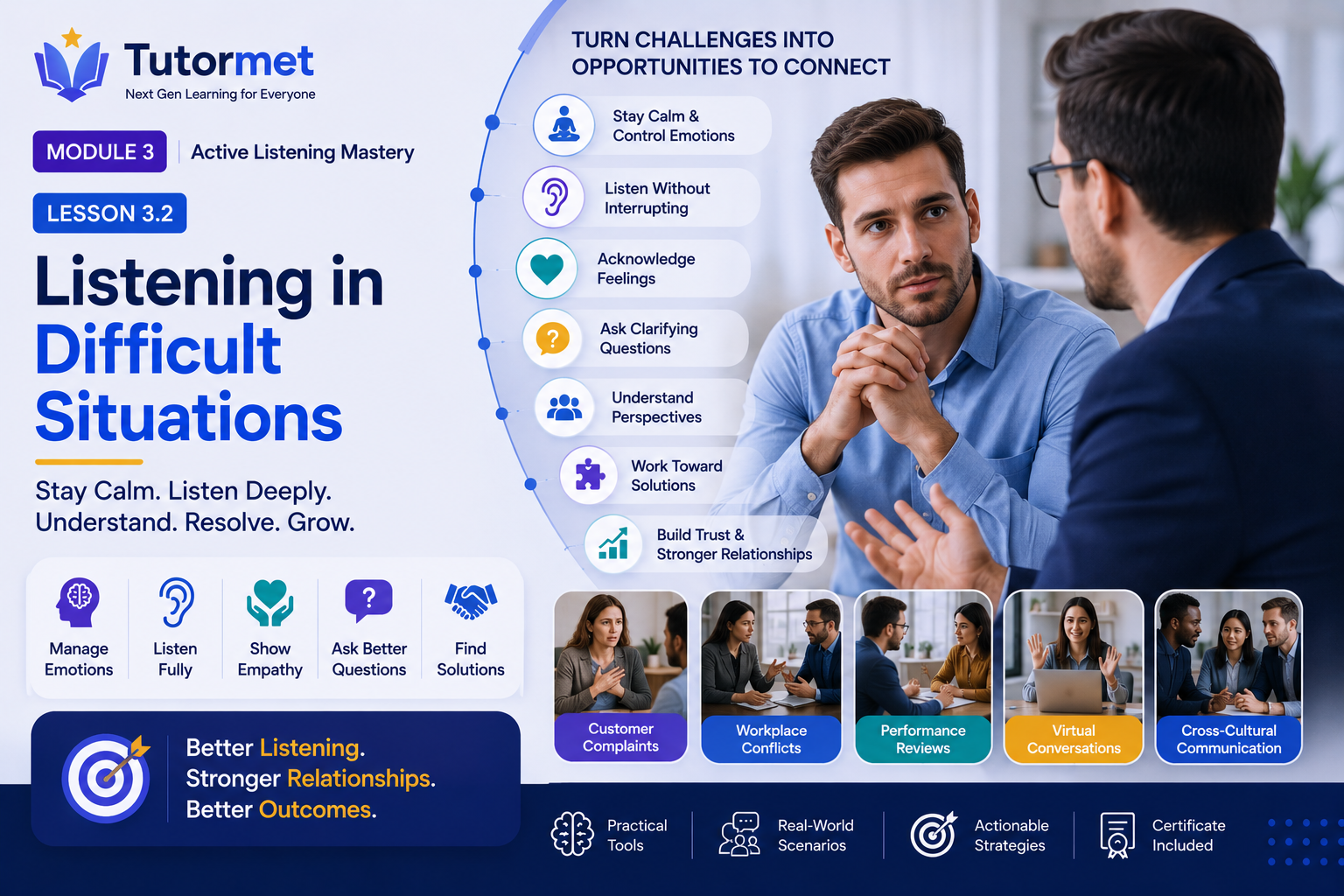
Lesson Description
Listening is easy when conversations are pleasant and everyone agrees. The true test of communication, however, comes during difficult situations—when emotions run high, opinions differ, problems arise, or important decisions must be made.
Whether you’re handling customer complaints, resolving workplace conflicts, supporting a family member, participating in performance reviews, or managing challenging online discussions, your ability to listen calmly and empathetically can determine the outcome of the conversation.
This lesson teaches practical strategies for listening effectively during emotionally charged, high-pressure, and difficult conversations while maintaining professionalism, empathy, and emotional control.
Learning Objectives
By the end of this lesson, you will be able to:
- Stay calm and focused during difficult conversations.
- Listen with empathy in emotionally challenging situations.
- Handle disagreements professionally.
- Support others without making assumptions.
- Communicate effectively during customer complaints and workplace conflicts.
- Listen respectfully during online and virtual discussions.
- Apply structured techniques for resolving difficult conversations.
1. Why Difficult Conversations Matter
Every person encounters difficult conversations.
Examples include:
- Receiving negative feedback
- Giving constructive criticism
- Customer complaints
- Workplace disagreements
- Performance evaluations
- Family conflicts
- Team misunderstandings
- Project delays
- Negotiations
- Emotional discussions
Many people focus on finding the “right words”.
However, successful difficult conversations begin with effective listening.
People become more cooperative when they feel genuinely heard.
2. Managing Your Emotions Before Listening
Strong emotions reduce our ability to listen objectively.
Before responding:
Pause.
Take a slow breath.
Focus on understanding rather than defending yourself.
Emotional Triggers
Common triggers include:
- Criticism
- Personal attacks
- Feeling misunderstood
- Unfair treatment
- Stress
- Time pressure
- High expectations
Recognising your emotional triggers helps prevent impulsive reactions.
The Pause Principle
Before responding:
- Stop.
- Breathe.
- Listen completely.
- Think carefully.
- Respond respectfully.
A few seconds of thoughtful silence often prevent unnecessary conflict.
3. Listening During Emotional Conversations
People experiencing strong emotions often want understanding before solutions.
Imagine a colleague saying:
“I’ve been working overtime every week and I feel completely exhausted.”
Poor response:
“Everyone is busy.”
Better response:
“It sounds like you’ve been under a lot of pressure lately. Tell me more about what’s been happening.”
Acknowledging emotions helps reduce tension and encourages honest communication.
Emotional Listening Tips
- Allow people to express themselves.
- Avoid interrupting.
- Validate emotions without immediately judging them.
- Stay calm.
- Avoid defensive language.
Remember:
Validating feelings does not necessarily mean agreeing with every opinion.
4. Listening During Workplace Conflicts
Disagreements are natural in professional environments.
Effective listeners focus on solving problems—not winning arguments.
Best Practices
Listen to each person’s perspective completely.
Avoid taking sides too early.
Summarise what each person has said.
Ask clarifying questions.
Focus on shared goals.
Encourage respectful discussion.
Seek solutions rather than assigning blame.
Example
Employee A:
“The deadline changed without informing me.”
Instead of immediately responding:
“That’s not true.”
Try:
“Can you explain when you became aware of the change?”
Questions encourage understanding.
Arguments often stop communication.
5. Listening to Customer Complaints
Customer complaints provide valuable information.
A frustrated customer wants to know that their concerns are taken seriously.
Effective Customer Listening Process
Step 1
Listen completely.
Do not interrupt.
Step 2
Acknowledge the concern.
Example:
“I understand why this situation would be frustrating.”
Step 3
Clarify the issue.
Ask questions to gather accurate information.
Step 4
Summarise the problem.
Example:
“So the product arrived later than expected and one item was missing.”
Step 5
Discuss possible solutions.
Focus on resolving the issue rather than defending the company.
Excellent customer service begins with excellent listening.
6. Listening During Performance Reviews
Performance reviews often create anxiety.
Managers should listen carefully before offering recommendations.
Employees should listen openly before becoming defensive.
For Managers
- Encourage honest discussion.
- Ask open-ended questions.
- Listen without interrupting.
- Recognise achievements.
- Discuss improvement collaboratively.
For Employees
- Listen completely.
- Ask clarifying questions.
- Request examples.
- Accept constructive feedback professionally.
- Develop an improvement plan.
Feedback becomes valuable when it is understood, not resisted.
7. Listening in Family and Personal Relationships
Many personal conflicts arise because people feel unheard.
Healthy relationships depend on emotional listening.
Helpful Practices
Give full attention.
Avoid checking your phone.
Show empathy.
Ask thoughtful questions.
Respect differences.
Focus on understanding rather than proving yourself right.
Sometimes the greatest gift you can offer someone is your attention.
8. Listening in Online and Virtual Conversations
Digital communication introduces unique challenges.
Virtual conversations often lack important nonverbal cues.
Challenges
- Internet delays
- Audio problems
- Lack of eye contact
- Multitasking
- Misinterpreted tone
- Camera fatigue
Best Practices
- Join meetings prepared.
- Eliminate distractions.
- Maintain eye contact with the camera.
- Allow people time to finish speaking.
- Confirm understanding before moving forward.
- Summarise key discussion points.
Clear communication reduces confusion in virtual environments.
9. Difficult Conversations Across Cultures
Global workplaces require cultural awareness.
Communication styles differ between cultures.
Some cultures communicate directly.
Others communicate more indirectly.
Neither approach is inherently better.
Cross-Cultural Listening Tips
Avoid assumptions.
Ask respectful questions.
Use simple language.
Speak clearly.
Allow additional time for responses.
Confirm understanding.
Respect cultural differences in communication styles.
Curiosity creates stronger international relationships.
10. A Practical Framework for Difficult Conversations
Use the C.A.L.M. Framework whenever conversations become challenging.
C — Control Your Emotions
Pause before reacting.
↓
A — Acknowledge Feelings
Recognise the speaker’s emotions.
↓
L — Listen Completely
Do not interrupt.
Ask thoughtful questions.
↓
M — Move Toward Solutions
Work together to find constructive next steps.
This simple framework encourages respectful, solution-focused conversations.
Real-World Scenario
James is a team leader managing an international software development project.
A developer joins a meeting visibly frustrated.
Instead of immediately discussing deadlines, James asks,
“I noticed you seem concerned. Would you like to explain what’s happening?”
The developer explains that unclear project requirements have caused repeated delays.
James listens without interrupting, summarises the concern, asks follow-up questions, and works with the team to clarify expectations.
The outcome:
- Misunderstandings are resolved.
- Team morale improves.
- Future delays are reduced.
- Trust between team members increases.
James solved the problem because he listened before leading.
Difficult Conversation Blueprint
Pause
↓
Control Emotions
↓
Listen Without Interrupting
↓
Acknowledge Feelings
↓
Ask Clarifying Questions
↓
Summarize Understanding
↓
Explore Solutions Together
↓
Agree on Next Steps
↓
Strengthen the Relationship
Key Takeaways
- Difficult conversations require more listening than speaking.
- Managing your own emotions helps you respond thoughtfully instead of reacting impulsively.
- Empathy and emotional validation reduce tension and encourage open dialogue.
- Workplace conflicts are best resolved by understanding perspectives before proposing solutions.
- Customer complaints provide opportunities to improve service and build trust.
- Performance reviews are more effective when both parties listen actively.
- Strong personal relationships depend on feeling heard and understood.
- Virtual and cross-cultural communication require extra attention, patience, and clarity.
- The C.A.L.M. Framework provides a simple approach for navigating emotionally challenging conversations.
- Great communicators are measured not by how well they argue, but by how well they understand others.
Practice Activity
Over the next week, identify one conversation that you expect may be difficult—at work, at home, or in another setting.
Before the conversation:
- Review the C.A.L.M. Framework.
- Set a goal to understand before responding.
During the conversation:
- Listen without interrupting.
- Acknowledge the other person’s perspective.
- Ask at least two clarifying questions.
- Summarise what you heard before sharing your own viewpoint.
Afterward, reflect on these questions:
- Did you remain calm throughout the conversation?
- Did the other person feel heard?
- Which listening strategy worked best?
- What would you do differently next time?
Every difficult conversation is an opportunity to strengthen your listening skills, build trust, and become a more effective communicator.