Lesson Description
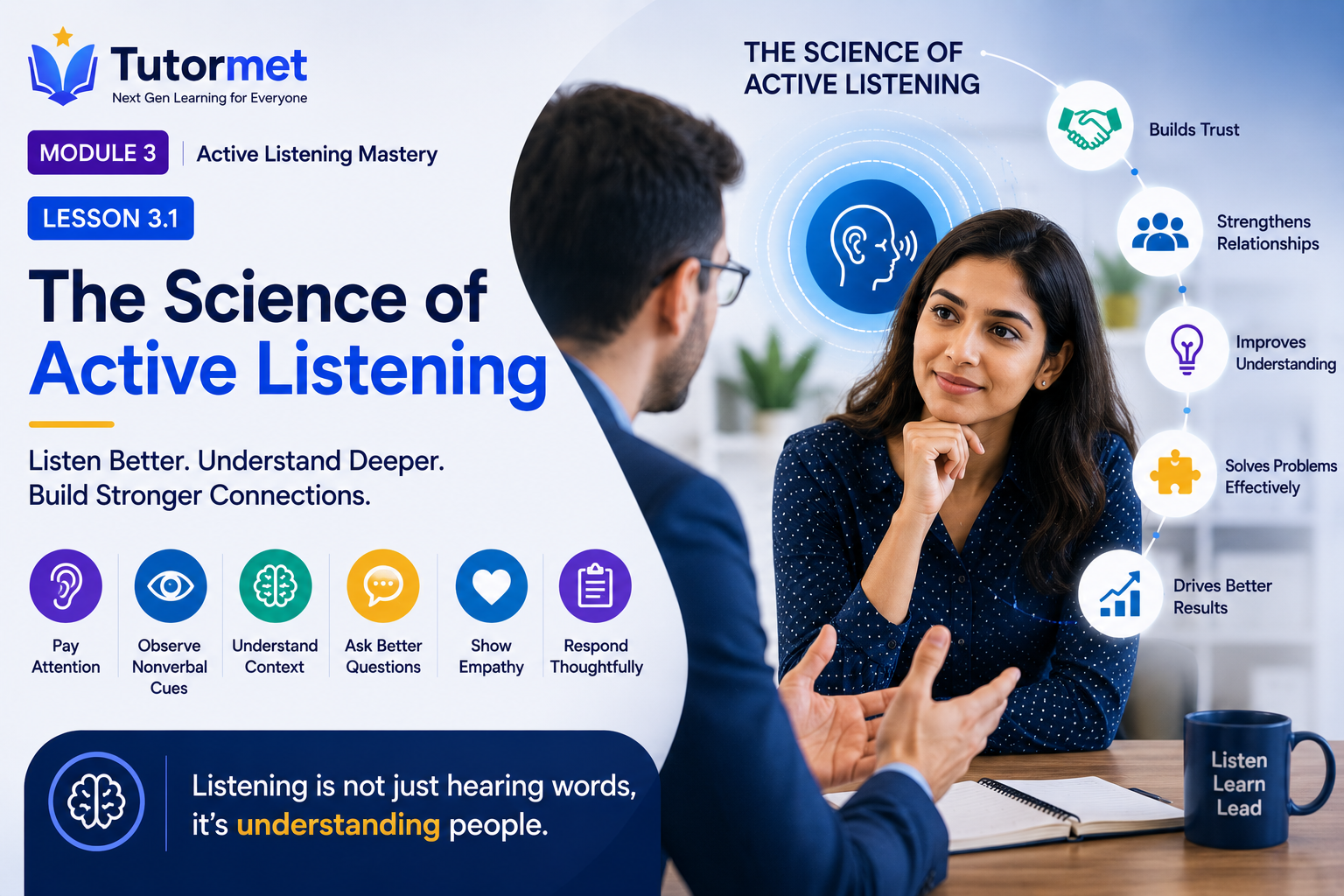
Communication is often associated with speaking, but exceptional communicators are first and foremost exceptional listeners. Active listening is one of the most valuable professional and personal skills because it builds trust, strengthens relationships, improves collaboration, reduces misunderstandings, and helps solve problems more effectively.
In today’s fast-paced world filled with emails, notifications, social media, virtual meetings, and AI-assisted communication, people are often distracted rather than truly listening. As a result, important information is missed, relationships suffer, and communication becomes less effective.
This lesson explores the science behind active listening, explains why listening is more than simply hearing words, and introduces practical techniques for becoming a more attentive, empathetic, and effective listener.
Learning Objectives
By the end of this lesson, you will be able to:
- Differentiate between hearing and active listening.
- Understand the psychological principles behind effective listening.
- Practice empathetic and reflective listening.
- Ask better questions to deepen conversations.
- Improve listening skills in professional and personal settings.
- Avoid common listening mistakes.
- Build stronger relationships through active listening.
1. What Is Active Listening?
Listening is not a passive activity.
Active listening is the deliberate process of fully concentrating on, understanding, responding to, and remembering what another person is communicating.
It involves much more than simply hearing words.
Active listeners pay attention to:
- Words
- Tone of voice
- Facial expressions
- Body language
- Emotions
- Intentions
- Context
The goal is not simply to reply—it is to understand.
Why Active Listening Matters
Strong listening skills help you:
- Build trust
- Reduce misunderstandings
- Improve teamwork
- Strengthen leadership
- Resolve conflicts
- Learn faster
- Make better decisions
- Increase customer satisfaction
- Build lasting relationships
People are more likely to trust those who genuinely listen to them.
2. Hearing vs. Listening
Many people use the terms interchangeably, but they are very different.
Hearing
Hearing is a physical process.
It happens automatically when sound reaches your ears.
No effort is required.
Example:
You hear traffic while walking down the street.
Listening
Listening is a mental and emotional process.
It requires:
- Attention
- Interpretation
- Understanding
- Memory
- Response
Example:
A manager carefully listens to an employee’s concerns before offering guidance.
Listening is an intentional choice.
Comparison
| Hearing | Active Listening |
|---|---|
| Automatic | Intentional |
| Passive | Active |
| Physical | Mental and emotional |
| Receives sounds | Understands meaning |
| No concentration required | Requires focus |
| Often forgotten | More likely to be remembered |
3. The Science Behind Active Listening
Modern research in psychology and neuroscience shows that effective listening strengthens communication because it improves understanding and reduces cognitive bias.
When people feel heard:
- Stress levels often decrease.
- Trust increases.
- Cooperation improves.
- Problem-solving becomes easier.
- Relationships become stronger.
The human brain naturally seeks understanding and validation.
Feeling genuinely heard satisfies an important psychological need.
4. Components of Active Listening
Effective listening involves several interconnected skills.
Paying Full Attention
Focus entirely on the speaker.
Avoid:
- Looking at your phone.
- Checking emails.
- Thinking about your response.
- Interrupting.
Give the speaker your complete attention.
Observing Nonverbal Signals
Communication is more than words.
Notice:
- Eye contact
- Facial expressions
- Gestures
- Posture
- Speaking speed
- Tone
These cues often reveal emotions that words alone cannot express.
Understanding Context
Consider:
- Why is the person speaking?
- What problem are they trying to solve?
- What emotions are involved?
- What information may be left unsaid?
Context helps prevent misunderstandings.
Responding Thoughtfully
Good listeners respond after understanding.
Responses may include:
- Questions
- Clarification
- Summaries
- Encouragement
Avoid reacting impulsively.
5. Empathetic Listening
Empathy means understanding another person’s feelings and perspective.
Empathetic listening focuses on understanding before offering advice.
Example
A colleague says:
“I’m overwhelmed by my workload.”
Poor response:
“Everyone is busy.”
Empathetic response:
“That sounds challenging. What’s creating the biggest difficulty right now?”
The second response encourages trust and deeper conversation.
Benefits
Empathetic listening:
- Builds relationships
- Reduces conflict
- Creates psychological safety
- Encourages honest communication
- Improves teamwork
6. Reflective Listening
Reflective listening means confirming your understanding by restating or summarizing what the speaker has said.
This technique reduces misunderstandings.
Examples
Speaker:
“I’m worried about meeting the deadline.”
Listener:
“So you’re concerned that the project timeline may be too short.”
Another example:
“It sounds like your main concern is balancing quality with the deadline.”
Reflection shows that you are paying attention.
Benefits
Reflective listening:
- Confirms understanding.
- Encourages clarification.
- Builds trust.
- Prevents assumptions.
- Improves collaboration.
7. Asking Better Questions
Great listeners ask thoughtful questions.
Questions encourage deeper understanding.
Open-Ended Questions
Open-ended questions encourage detailed responses.
Examples:
- What happened?
- How did you approach the situation?
- What challenges did you face?
- What outcome are you hoping for?
- How can I help?
Closed Questions
Closed questions usually produce short answers.
Examples:
- Did you finish?
- Is everything okay?
- Are you available?
Closed questions are useful when specific information is needed.
Clarifying Questions
Clarifying questions remove ambiguity.
Examples:
- Could you explain that further?
- What do you mean by that?
- Can you give an example?
Clarification prevents misunderstandings.
8. Listening in Professional Settings
Active listening improves workplace communication.
Examples include:
- Team meetings
- Performance reviews
- Customer support
- Sales discussions
- Project planning
- Interviews
- Negotiations
Professionals who listen well often make better decisions because they understand situations more completely.
9. Common Listening Mistakes
Avoid these habits:
Interrupting
Allow people to finish speaking.
Assuming
Do not assume you already know what someone will say.
Multitasking
Checking messages during conversations reduces attention.
Planning Your Response Too Early
Many people stop listening because they begin preparing their reply.
Listen first.
Respond second.
Judging Too Quickly
Avoid forming opinions before hearing the complete message.
Giving Unwanted Advice
Sometimes people simply want to be heard.
Ask:
“Would you like my advice, or would you prefer that I simply listen?”
10. Active Listening in the AI Era
Technology has transformed communication, but listening remains a uniquely human strength.
AI tools can:
- Transcribe meetings
- Summarize conversations
- Organize notes
- Translate languages
However, AI cannot fully replace:
- Empathy
- Emotional understanding
- Human intuition
- Relationship-building
- Ethical judgment
Professionals who combine AI tools with excellent listening skills will communicate more effectively in the future workplace.
Practical Active Listening Framework
Use the L.I.S.T.E.N. Framework during conversations:
L — Look
Maintain appropriate eye contact and observe body language.
↓
I — Ignore Distractions
Put away phones and focus completely.
↓
S — Show Interest
Nod, smile naturally, and use encouraging responses.
↓
T — Think Before Responding
Pause before speaking.
↓
E — Empathize
Try to understand the speaker’s feelings and perspective.
↓
N — Notice Key Ideas
Remember the main points and summarize when appropriate.
Real-World Scenario
Maria is leading a project meeting.
One team member quietly says,
“I’m concerned we may not finish this feature on time.”
Instead of immediately defending the schedule, Maria asks,
“Can you explain what’s causing the delay?”
She listens carefully, summarizes the concern, asks follow-up questions, and encourages the team to discuss possible solutions.
As a result:
- The real problem is identified.
- Team members feel respected.
- A better project plan is created.
- Trust within the team increases.
The outcome improves not because Maria spoke more—but because she listened better.
Key Takeaways
- Active listening is a deliberate process of understanding, not just hearing.
- Listening requires attention, empathy, interpretation, and thoughtful responses.
- Hearing is automatic; active listening is intentional.
- Empathetic listening strengthens relationships by recognizing emotions and perspectives.
- Reflective listening confirms understanding and reduces misunderstandings.
- Open-ended and clarifying questions lead to deeper, more meaningful conversations.
- Avoid interruptions, assumptions, multitasking, and premature judgments.
- In an AI-powered world, human listening skills remain essential for leadership, teamwork, customer relationships, and effective communication.
- Becoming a better listener is one of the fastest ways to become a better communicator.
Practice Activity
For the next 24 hours, choose one conversation—at work, at home, or with a friend—and intentionally practice active listening.
During the conversation:
- Give the speaker your full attention.
- Do not interrupt.
- Ask at least two open-ended questions.
- Summarize one key point before responding.
- Notice the speaker’s tone and body language.
After the conversation, reflect on these questions:
- Did the speaker seem more engaged?
- What new information did you learn because you listened carefully?
- Which listening habit was easiest for you?
- Which habit do you still need to improve?
Remember: The best communicators are not always the best speakers—they are often the best listeners.