Lesson Description
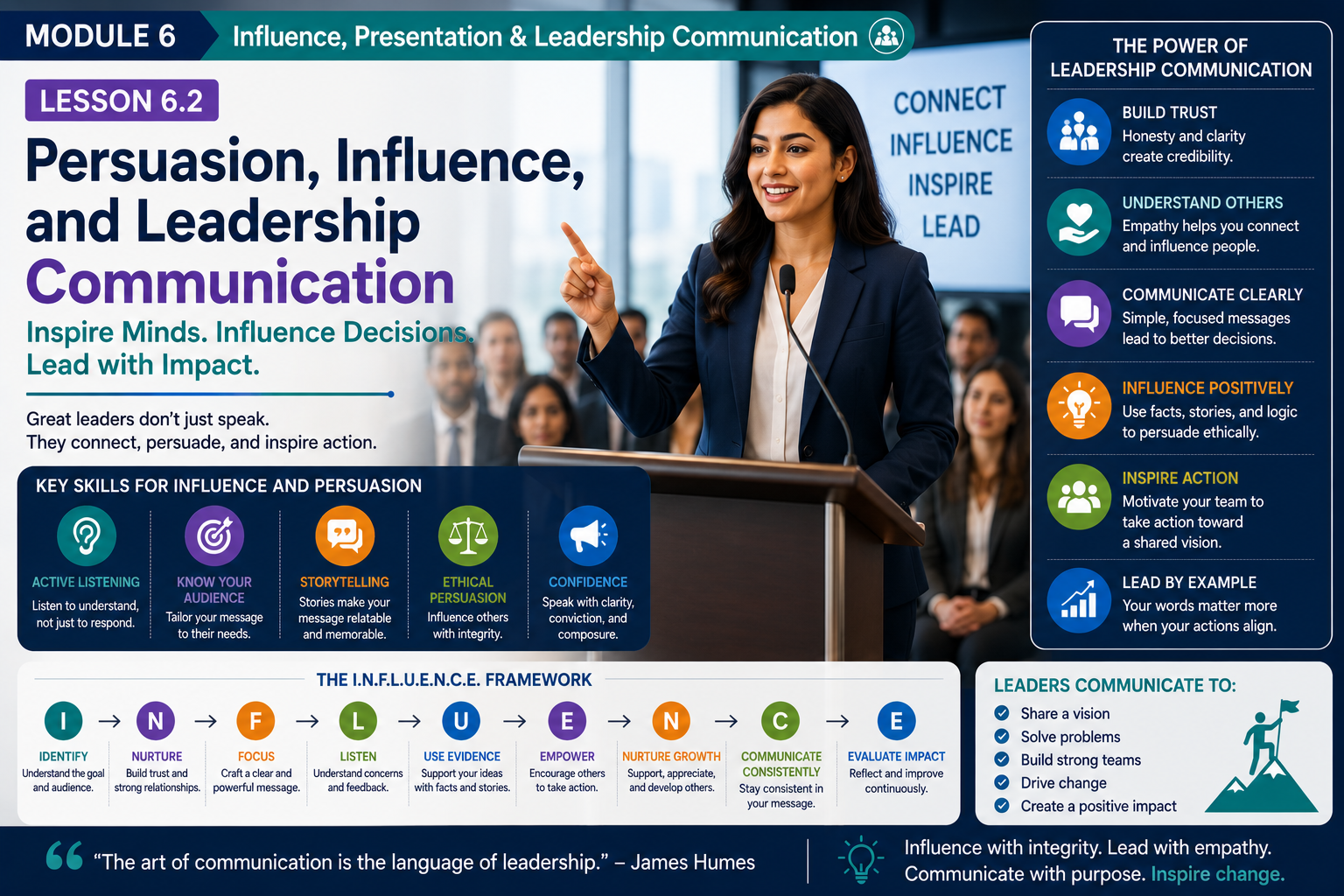
Great communicators do more than share information—they inspire action. Whether you’re leading a team, presenting a business proposal, negotiating with clients, motivating employees, teaching students, raising funds for a cause, or encouraging positive change, your ability to persuade and influence ethically is one of the most valuable leadership skills.
Persuasion is not about manipulating people. It is about communicating ideas clearly, building trust, presenting evidence, understanding different perspectives, and helping others make informed decisions. In today’s AI-powered and globally connected world, leaders who communicate with authenticity, empathy, and credibility are more influential than ever.
This lesson explores the psychology of persuasion, ethical influence, leadership communication, and practical techniques used by successful leaders, entrepreneurs, educators, and public speakers worldwide.
Learning Objectives
By the end of this lesson, you will be able to:
- Understand the principles of ethical persuasion.
- Differentiate persuasion from manipulation.
- Build credibility and trust with audiences.
- Use logical reasoning and emotional intelligence effectively.
- Communicate as a confident leader.
- Inspire action through storytelling and clear calls to action.
- Influence others ethically in professional and personal settings.
1. What Is Persuasion?
Persuasion is the process of influencing someone’s beliefs, attitudes, or actions through clear, ethical, and respectful communication.
The goal is not to force agreement.
The goal is to help people understand, evaluate, and make informed decisions.
Examples include:
- Convincing a manager to approve a project.
- Presenting a business idea to investors.
- Encouraging healthy habits.
- Inspiring a team during change.
- Motivating students to learn.
- Influencing customers to choose a solution.
Effective persuasion creates value for both the speaker and the audience.
Persuasion vs. Manipulation
These concepts are often confused.
| Ethical Persuasion | Manipulation |
|---|---|
| Honest | Misleading |
| Transparent | Hidden motives |
| Respects choice | Pressures decisions |
| Evidence-based | Emotionally exploitative |
| Builds trust | Damages trust |
| Long-term relationships | Short-term gains |
Professional communicators always choose ethical persuasion.
2. Building Credibility
People are more likely to accept ideas from communicators they trust.
Credibility is built through:
- Knowledge
- Honesty
- Consistency
- Preparation
- Professionalism
- Integrity
Three Pillars of Credibility
Competence
Demonstrate expertise.
Know your subject.
Support claims with reliable evidence.
Character
Be honest.
Keep promises.
Admit mistakes.
Respect others.
Connection
Show empathy.
Understand audience needs.
Build relationships before asking for action.
Trust grows over time through consistent behavior.
3. Understanding Your Audience
Persuasive communication begins with empathy.
Ask:
- What does my audience care about?
- What challenges are they facing?
- What motivates them?
- What concerns might they have?
- What evidence will they trust?
People support ideas that solve their problems.
Audience-Centered Communication
Instead of saying:
“Here’s what I want.”
Think:
“Here’s how this benefits you.”
Audience-focused communication creates stronger influence.
4. Using Logic and Evidence
Persuasive communication requires clear reasoning.
Support your ideas using:
- Facts
- Research
- Data
- Examples
- Case studies
- Demonstrations
- Expert opinions
Evidence strengthens credibility.
Avoid making unsupported claims.
5. Emotional Intelligence in Persuasion
People make decisions using both logic and emotion.
Emotion creates connection.
Logic provides justification.
Strong communicators understand both.
Emotional Intelligence Skills
- Self-awareness
- Emotional control
- Empathy
- Active listening
- Respectful responses
- Adaptability
Understanding emotions helps you communicate more effectively.
6. Storytelling for Influence
Stories help audiences remember ideas.
Instead of presenting only statistics, explain how those numbers affect real people.
Example Story Structure
Situation
↓
Challenge
↓
Decision
↓
Action
↓
Result
↓
Lesson
Stories transform information into meaningful experiences.
7. Leadership Communication
Leadership is communication in action.
Effective leaders communicate:
- Vision
- Purpose
- Expectations
- Encouragement
- Feedback
- Recognition
They also listen actively.
Leadership is not only about speaking—it is about creating understanding.
Leadership Communication Habits
- Be clear.
- Be honest.
- Be consistent.
- Encourage collaboration.
- Recognize achievements.
- Address problems respectfully.
- Communicate regularly.
Consistency builds confidence.
8. Inspiring Action
The purpose of many presentations is action.
After understanding your message, your audience should know:
- What should they do?
- Why should they do it?
- When should they act?
- How can they begin?
Always end with a clear call to action.
Example
Instead of saying:
“Thank you.”
Try:
“This week, identify one communication habit you want to improve and practice it every day.”
Clear actions increase impact.
9. Handling Objections Professionally
Disagreement is a normal part of persuasion.
Professional communicators welcome questions.
Best Practices
Listen carefully.
Acknowledge concerns.
Ask clarifying questions.
Respond respectfully.
Use evidence.
Remain calm.
Never attack the individual.
Respectful discussion builds credibility.
10. Persuasion in the AI Era
Artificial Intelligence can support persuasive communication by helping with:
- Research
- Data analysis
- Presentation design
- Writing assistance
- Audience insights
- Language translation
However, AI cannot replace:
- Authentic leadership
- Human empathy
- Ethical judgment
- Trust
- Personal relationships
Technology can strengthen communication, but character remains the foundation of influence.
The I.N.S.P.I.R.E. Framework
Use the I.N.S.P.I.R.E. Framework whenever you need to persuade or lead others.
I — Identify the Audience
Understand their goals, needs, and concerns.
↓
N — Notice Their Perspective
Listen actively and acknowledge different viewpoints.
↓
S — Support Ideas with Evidence
Use facts, examples, and logical reasoning.
↓
P — Present with Confidence
Speak clearly and professionally.
↓
I — Inspire Through Stories
Use real-life examples to create emotional connection.
↓
R — Respect Different Opinions
Handle disagreements with professionalism.
↓
E — Encourage Positive Action
End with a clear and meaningful call to action.
Real-World Scenario
Aisha is leading a nonprofit organization seeking volunteers for a community literacy program.
Instead of simply asking people to volunteer, she begins by sharing the story of a child whose reading skills improved through the program. She then presents data showing the program’s impact, explains how volunteers can make a difference, answers questions honestly, and concludes with a simple invitation to register.
Her presentation succeeds because it combines empathy, evidence, credibility, and a clear call to action.
People are inspired not only by the information but also by the purpose behind it.
Persuasive Communication Blueprint
Understand the Audience
↓
Build Trust
↓
Present Clear Evidence
↓
Connect Through Stories
↓
Communicate with Confidence
↓
Handle Questions Respectfully
↓
Offer a Clear Call to Action
↓
Build Long-Term Relationships
Key Takeaways
- Persuasion is the ethical process of influencing others through trust, clarity, and evidence.
- Manipulation seeks short-term gains, while ethical persuasion builds long-term relationships.
- Credibility is based on competence, character, and connection.
- Audience-centered communication is more effective than self-centered communication.
- Strong persuasion combines logic with emotional intelligence.
- Storytelling helps audiences remember and relate to your message.
- Leadership communication involves vision, consistency, empathy, and active listening.
- Objections should be handled respectfully and professionally.
- AI can support persuasive communication but cannot replace authenticity or ethical judgment.
- The I.N.S.P.I.R.E. Framework provides a practical roadmap for ethical influence and leadership communication.
Practice Activity
Choose one idea that you would like to persuade someone to support—for example:
- A workplace improvement
- A community initiative
- A new business idea
- A healthy lifestyle habit
- A learning or education program
Prepare a 3-minute persuasive presentation using the I.N.S.P.I.R.E. Framework:
- I – Identify your audience and their needs.
- N – Consider their perspective and possible concerns.
- S – Support your idea with facts or examples.
- P – Present confidently and clearly.
- I – Include one short, meaningful story.
- R – Prepare respectful responses to possible objections.
- E – End with a clear call to action.
After practicing, reflect on these questions:
- Did I build trust before trying to persuade?
- Did I balance facts with emotion?
- Was my call to action specific and achievable?
- How could I make my message even more compelling?
The most influential communicators are not those who speak the loudest—they are those who communicate with clarity, integrity, empathy, and purpose.