Lesson Description
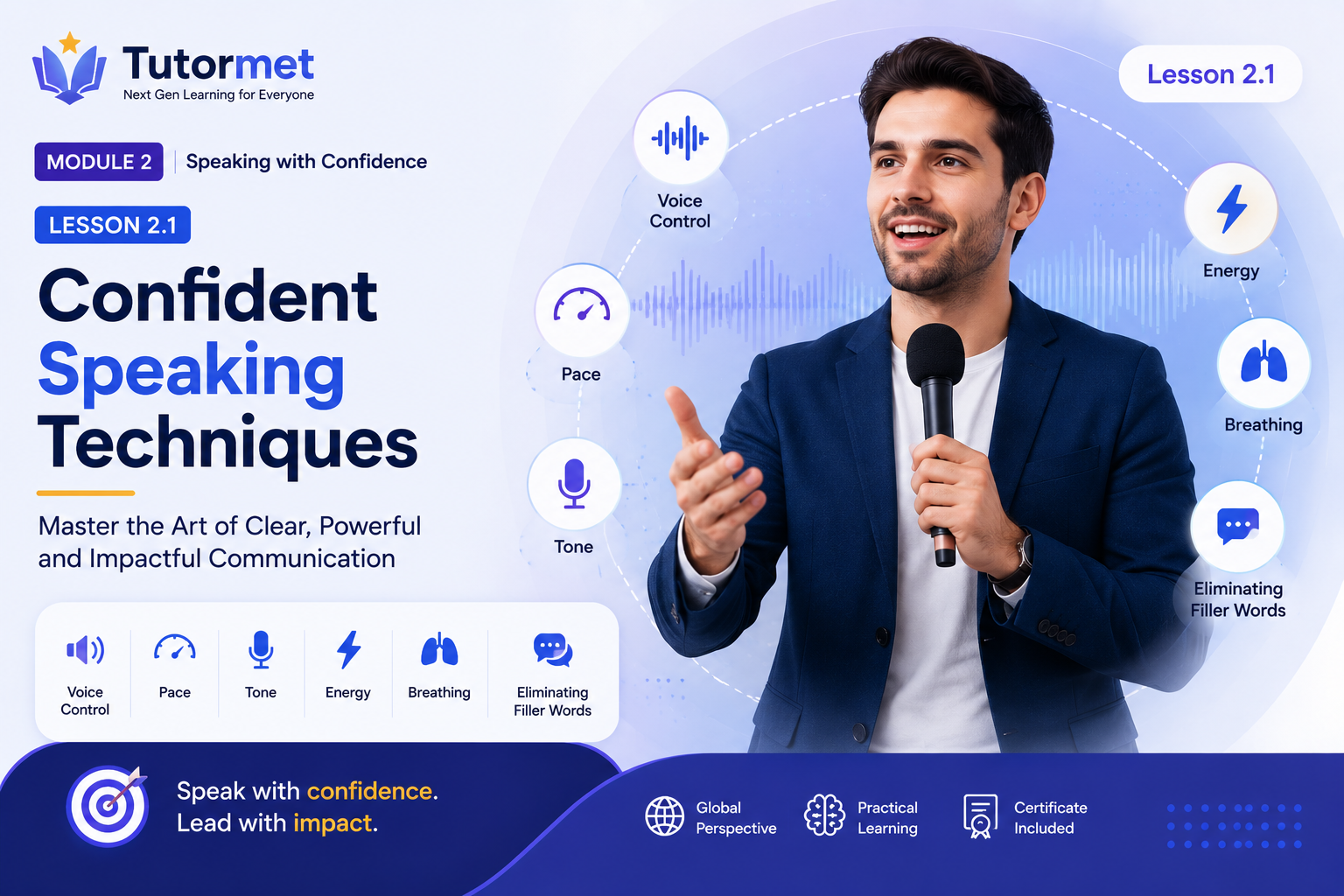
Speaking confidently is one of the most valuable communication skills in today’s professional world. Whether you’re participating in meetings, delivering presentations, attending job interviews, networking, or speaking with customers, the way you speak often influences how your ideas are received.
Confidence is not about speaking loudly or dominating conversations. It is about expressing your thoughts clearly, calmly, and authentically. Strong speakers know how to control their voice, maintain an appropriate pace, use the right tone, project positive energy, breathe effectively, and avoid distracting filler words.
In this lesson, you’ll learn practical techniques used by effective communicators, leaders, educators, and public speakers to speak with greater confidence and impact.
Learning Objectives
By the end of this lesson, you will be able to:
- Understand the key elements of confident speaking.
- Improve voice control and vocal clarity.
- Speak at an effective pace.
- Use tone to communicate emotion and meaning.
- Project positive speaking energy.
- Use breathing techniques to reduce nervousness.
- Minimize filler words and improve fluency.
1. Voice Control
Your voice is one of your most powerful communication tools.
People often judge confidence, credibility, and professionalism within the first few seconds of hearing someone speak.
Voice control refers to intentionally managing the following:
- Volume
- Pitch
- Clarity
- Projection
- Vocal variation
A controlled voice makes communication easier to understand and more engaging.
Why Voice Control Matters
A well-controlled voice helps you:
- Capture attention
- Build credibility
- Increase listener engagement
- Express confidence
- Improve message clarity
Components of Voice Control
Volume
Speak loudly enough to be heard comfortably.
Avoid:
- Speaking too softly
- Shouting unnecessarily
Adjust your volume based on:
- Audience size
- Environment
- Microphone usage
Pitch
Pitch refers to how high or low your voice sounds.
Monotonous speech often loses attention.
Natural variation makes speaking more interesting.
Clarity
Pronounce words clearly.
Avoid:
- Mumbling
- Speaking too quickly
- Slurring words together
Clear pronunciation improves understanding.
Projection
Projection means speaking from your diaphragm rather than your throat.
Good projection allows your voice to carry naturally without strain.
Practice Exercise
Read a paragraph aloud.
Record yourself.
Evaluate:
- Was every word understandable?
- Did your voice sound energetic?
- Did you vary your pitch?
- Was your volume consistent?
2. Pace
“Pace” refers to the speed at which you speak.
Speaking too fast can overwhelm listeners.
Speaking too slowly can reduce engagement.
The goal is a comfortable, conversational rhythm.
Fast Pace
Advantages
- Creates excitement
- Shows enthusiasm
Disadvantages
- Difficult to follow
- Increases mistakes
- Reduces clarity
Slow Pace
Advantages
- Easier to understand
- Gives listeners time to think
Disadvantages
- May sound hesitant
- Can reduce energy if overused
The Ideal Pace
Effective speakers:
- Slow down for important ideas.
- Pause after key points.
- Speed up slightly during stories.
- Adjust pace based on audience understanding.
The Power of Pauses
Silence is part of communication.
Strategic pauses:
- Build anticipation.
- Increase impact.
- Give listeners time to process information.
- Help you gather your thoughts.
A confident speaker is not afraid of a brief silence.
3. Tone
Tone reflects your attitude and emotions.
The same sentence can have completely different meanings depending on tone.
For example:
“I appreciate your help.”
Can sound:
- Genuine
- Sarcastic
- Angry
- Excited
- Grateful
The words remain the same.
The tone changes everything.
Types of Professional Tone
Friendly
Builds relationships.
Suitable for:
- Teamwork
- Networking
- Customer service
Professional
Clear and respectful.
Suitable for:
- Meetings
- Presentations
- Business communication
Persuasive
Used to influence decisions.
Suitable for:
- Sales
- Leadership
- Negotiation
Empathetic
Shows understanding and compassion.
Suitable for:
- Difficult conversations
- Coaching
- Customer support
Choosing the Right Tone
Consider:
- Who is your audience?
- What is the purpose?
- What emotions should your message convey?
Effective communicators adapt their tone to each situation.
4. Energy
Energy is the enthusiasm and engagement you bring to your communication.
People often respond more to your energy than your words.
High energy does not mean speaking loudly.
It means showing genuine interest, positivity, and confidence.
Signs of Positive Speaking Energy
- Good posture
- Genuine smile
- Eye contact
- Natural gestures
- Vocal variation
- Enthusiasm
- Positive attitude
Low-Energy Communication
Characteristics include:
- Monotone voice
- Poor posture
- Little facial expression
- Minimal enthusiasm
- Lack of engagement
Even excellent ideas may lose impact when presented with low energy.
Increasing Speaking Energy
- Stand confidently.
- Smile naturally.
- Use expressive gestures.
- Make eye contact.
- Focus on helping your audience rather than impressing them.
Authentic enthusiasm is contagious.
5. Breathing
Breathing is often overlooked but plays a crucial role in confident speaking.
Nervous speakers frequently:
- Hold their breath
- Breathe too quickly
- Speak without pausing
This leads to:
- Voice shaking
- Shortness of breath
- Reduced confidence
Diaphragmatic Breathing
Professional speakers breathe using the diaphragm rather than shallow chest breathing.
Benefits include:
- Better voice projection
- Reduced anxiety
- Improved vocal stability
- Greater endurance
Simple Breathing Exercise
Before speaking:
- Sit or stand comfortably.
- Inhale slowly through your nose for four seconds.
- Hold your breath for two seconds.
- Exhale slowly through your mouth for six seconds.
- Repeat three to five times.
This simple exercise helps calm your nervous system and prepares your voice.
During Presentations
Remember to breathe naturally.
Do not rush through sentences.
Use pauses to inhale comfortably.
Steady breathing supports steady speaking.
6. Eliminating Filler Words
Filler words are unnecessary words or sounds used while thinking.
Common examples include:
- Um
- Uh
- Like
- You know
- Basically
- Actually
- So
- I mean
Occasional filler words are natural.
However, excessive use can reduce clarity and confidence.
Why People Use Fillers
People often use filler words because they are:
- Thinking of the next idea.
- Feeling nervous.
- Speaking too quickly.
- Uncomfortable with silence.
Replace Fillers with Pauses
Instead of saying
“Um… I think… you know… we should…”
Pause.
Think.
Then continue.
A brief pause sounds far more confident than repeated filler words.
Strategies to Reduce Fillers
- Slow your pace.
- Organize your thoughts.
- Practice aloud.
- Record yourself.
- Embrace silence.
- Focus on clear ideas rather than perfect wording.
Awareness is the first step toward improvement.
Real-World Scenario
Imagine two professionals presenting the same proposal.
Speaker A
- Speaks too quickly.
- Uses frequent filler words.
- Avoids eye contact.
- Breathes rapidly.
- Maintains a flat tone.
Speaker B
- Speaks clearly.
- Uses purposeful pauses.
- Maintains a steady pace.
- Projects confidence.
- Uses vocal variety.
- Speaks with calm energy.
Even if both present identical information, Speaker B is more likely to earn trust, engage the audience, and leave a lasting impression.
Confident Speaking Blueprint
Breathing
↓
Calm Mind
↓
Voice Control
↓
Steady Pace
↓
Purposeful Tone
↓
Positive Energy
↓
Fewer Filler Words
↓
Confident Speaking
Key Takeaways
- Confidence comes from preparation and consistent practice, not perfection.
- Voice control improves clarity, credibility, and audience engagement.
- An effective speaking pace helps listeners understand and retain information.
- Tone communicates emotion, attitude, and intention.
- Positive energy makes your message more engaging and memorable.
- Proper breathing reduces anxiety and strengthens vocal delivery.
- Replacing filler words with thoughtful pauses creates a more confident and professional speaking style.
- Every conversation is an opportunity to strengthen your speaking skills.
Practice Activity
Choose a topic you enjoy, such as a hobby, favorite book, recent project, or travel experience.
Speak about it for two minutes while recording yourself.
After listening to the recording, evaluate the following:
- Was your voice clear and easy to understand?
- Did you maintain a comfortable pace?
- Did your tone match your message?
- Did you project positive energy?
- Did you breathe naturally?
- How many filler words did you use?
Repeat the exercise after making improvements. Comparing your recordings over time is one of the most effective ways to build lasting speaking confidence.