Lesson Description
In today’s digital world, written communication is one of the most important professional skills. Whether you’re sending emails, writing reports, messaging colleagues, creating proposals, posting on social media, or communicating with customers, your writing reflects your professionalism, credibility, and attention to detail.
Unlike face-to-face conversations, written communication does not include facial expressions, tone of voice, or body language. As a result, your choice of words, structure, and clarity become even more important. A well-written message saves time, prevents misunderstandings, and builds trust.
This lesson explores the principles of professional writing and teaches practical techniques for creating clear, concise, and effective written communication for today’s AI-powered workplace.
Learning Objectives
By the end of this lesson, you will be able to:
- Understand the importance of professional written communication.
- Write clear, concise, and reader-friendly messages.
- Organize information logically.
- Adapt your writing for different audiences.
- Improve grammar, tone, and readability.
- Use AI tools responsibly to enhance writing.
- Avoid common writing mistakes.
1. Why Written Communication Matters
Every day, professionals write:
- Emails
- Reports
- Business proposals
- Chat messages
- Meeting notes
- Project updates
- Customer responses
- Social media posts
- Technical documentation
- Knowledge articles
Your writing often creates your first impression before people meet you.
Clear writing helps people understand your message quickly and accurately.
Benefits of Strong Writing Skills
Effective writing helps you:
- Communicate ideas clearly.
- Reduce misunderstandings.
- Save time.
- Improve teamwork.
- Increase credibility.
- Build professional relationships.
- Support better decision-making.
- Strengthen leadership communication.
Good writing is a competitive career advantage.
2. Know Your Audience
Before writing, ask yourself:
- Who will read this?
- What do they already know?
- What information do they need?
- What action should they take?
- How formal should my writing be?
A message for a customer differs from a message for a close colleague.
Audience awareness improves communication effectiveness.
Examples
Email to a Customer
Professional, respectful, and detailed.
Team Chat
Friendly, concise, and collaborative.
Executive Report
Clear, structured, and data-driven.
Social Media Post
Engaging, conversational, and audience-focused.
Different audiences require different writing styles.
3. The Principles of Clear Writing
Professional writing should be:
Clear
Readers should immediately understand your message.
Avoid vague language.
Concise
Use only the words needed.
Avoid unnecessary repetition.
Correct
Ensure:
- Grammar
- Spelling
- Punctuation
- Facts
are accurate.
Complete
Include all necessary information.
Answer the reader’s likely questions.
Courteous
Be respectful and professional.
Even difficult messages should remain polite.
4. Organizing Your Message
Well-organized writing is easier to understand.
A simple structure works for most professional communication.
Step 1: Purpose
Begin with the main reason for writing.
Readers appreciate knowing the purpose immediately.
Step 2: Details
Provide supporting information.
Use:
- Short paragraphs
- Bullet points
- Headings
when appropriate.
Step 3: Action
Clearly explain:
- What should happen next?
- Who is responsible?
- When should action be taken?
End with a clear conclusion.
5. Writing Clear Sentences
Professional writing favors simplicity.
Strong Sentence Example
“The meeting begins at 10:00 a.m. “
Simple.
Direct.
Easy to understand.
Weak Sentence Example
“It has been decided that the meeting will commence at approximately 10 o’clock in the morning.”
Longer writing is not better writing.
Clear writing respects the reader’s time.
Tips
Use:
- Short sentences.
- Active voice.
- Familiar words.
- Logical order.
Readers understand simple writing more quickly.
6. Choosing the Right Tone
Tone reflects your attitude.
The same message can sound
- Friendly
- Professional
- Supportive
- Formal
- Persuasive
- Apologetic
Choose the tone that matches your audience and purpose.
Professional Tone
Example:
“Thank you for your feedback. We’ll review your suggestions and respond by Friday.”
Unprofessional Tone
Example:
“That’s not our fault.”
Professional writing remains respectful—even during disagreements.
7. Grammar and Proofreading
Small mistakes reduce credibility.
Before sending any important message:
Check:
- Grammar
- Spelling
- Punctuation
- Names
- Dates
- Attachments
- Links
One minute of proofreading can prevent costly misunderstandings.
Helpful Proofreading Tips
- Read your message aloud.
- Review it slowly.
- Check facts.
- Remove unnecessary words.
- Correct formatting.
Good editing improves good writing.
8. Using AI Responsibly
Modern AI tools can help improve writing.
Examples include:
- Grammar correction
- Summarization
- Translation
- Brainstorming
- Tone improvement
- Draft generation
However, AI should support—not replace—your judgment.
Best Practices
Use AI to:
- Generate first drafts.
- Improve clarity.
- Check grammar.
- Simplify language.
Always review AI-generated content for:
- Accuracy
- Confidentiality
- Bias
- Tone
- Relevance
You remain responsible for the final message.
9. Common Writing Mistakes
Avoid:
- Long paragraphs.
- Unclear purpose.
- Poor grammar.
- Excessive jargon.
- Overly complex sentences.
- Emotional language.
- Missing attachments.
- Unclear action requests.
- Inconsistent formatting.
- Sending messages without proofreading.
Professional writing is intentional.
10. Writing Across Cultures
Global communication requires clarity.
When writing for international audiences:
Use:
- Simple English.
- Short sentences.
- Standard vocabulary.
- Clear dates.
- Respectful language.
Avoid:
- Slang.
- Idioms.
- Local abbreviations.
- Cultural references that others may not understand.
Clarity improves global communication.
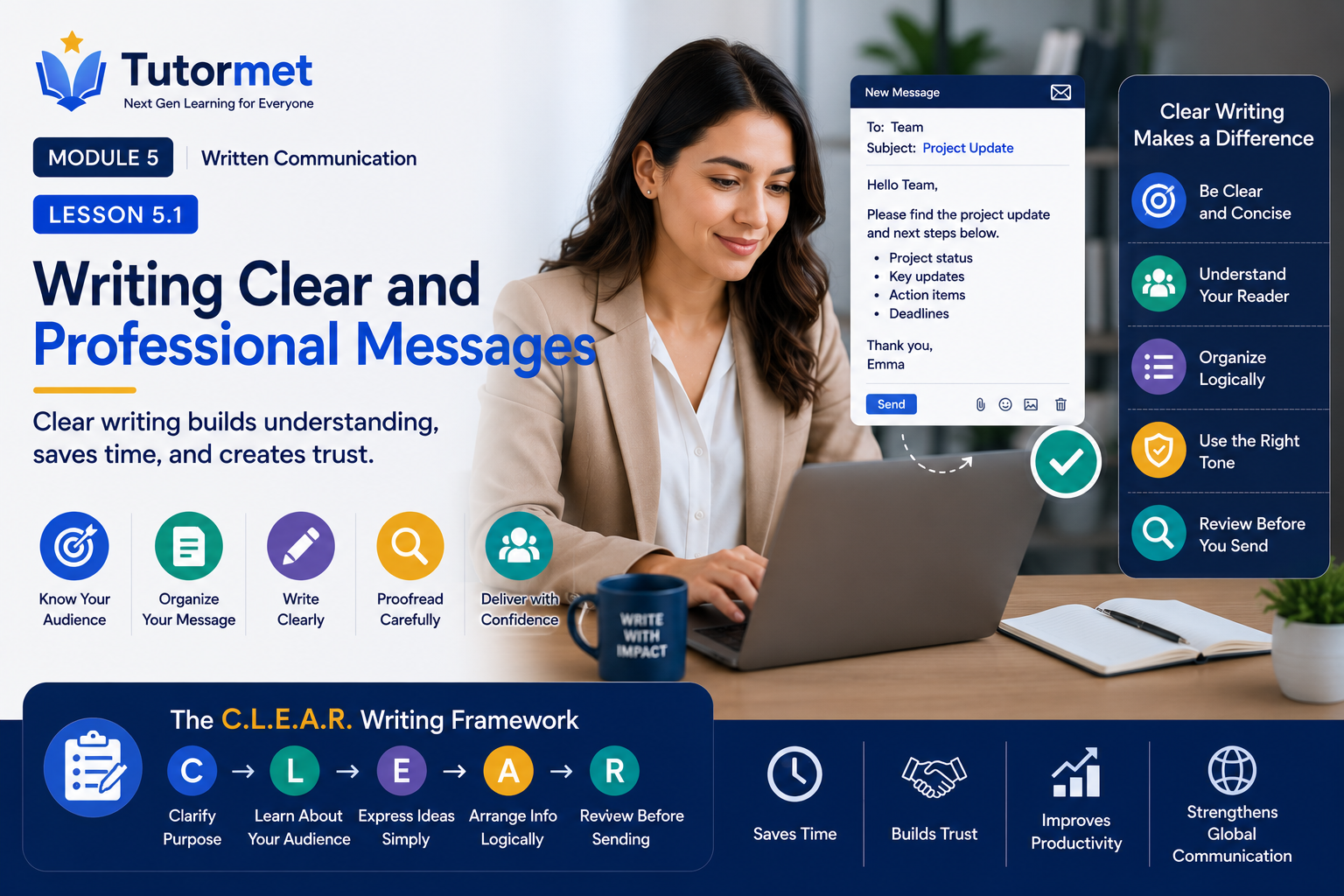
The C.L.E.A.R. Writing Framework
Use the C.L.E.A.R. Framework whenever you write.
C — Clarify Your Purpose
Know exactly why you’re writing.
↓
L — Learn About Your Audience
Adapt your message to the reader.
↓
E — Express Ideas Simply
Use clear, concise language.
↓
A — Arrange Information Logically
Present ideas in a logical order.
↓
R — Review Before Sending
Proofread for grammar, accuracy, tone, and completeness.
This framework helps create professional and effective written communication.
Real-World Scenario
Emma is managing an international marketing project.
Instead of sending a long, confusing email, she writes:
- A clear subject line.
- A brief introduction explaining the purpose.
- Bullet points outlining the required actions.
- Deadlines for each task.
- A polite closing thanking the team.
The team quickly understands their responsibilities, fewer clarification emails are needed, and the project stays on schedule.
Emma’s writing improves efficiency because it is clear, organized, and reader-focused.
Key Takeaways
- Written communication is a critical professional skill in the digital workplace.
- Effective writing is clear, concise, correct, complete, and courteous.
- Understanding your audience improves communication effectiveness.
- Organizing information logically helps readers understand your message quickly.
- Professional tone builds trust and credibility.
- Proofreading reduces errors and misunderstandings.
- AI tools can improve writing, but human review remains essential.
- Global communication benefits from simple language and cultural awareness.
- The C.L.E.A.R. Framework provides a practical process for writing effective messages.
- Strong writing saves time, strengthens relationships, and enhances professional success.
Practice Activity
Choose one professional message you recently wrote, such as an email, chat message, report, or meeting update.
Using the C.L.E.A.R. framework, revise it by asking:
- Is my purpose immediately clear?
- Is the message appropriate for my audience?
- Can I simplify any sentences?
- Is the information organized logically?
- Have I checked grammar, spelling, and tone?
- Does the message clearly explain the next action?
Compare your original version with the revised version.
Notice how small improvements in clarity, organization, and tone can make your writing more professional, easier to understand, and more effective.