Lesson Description
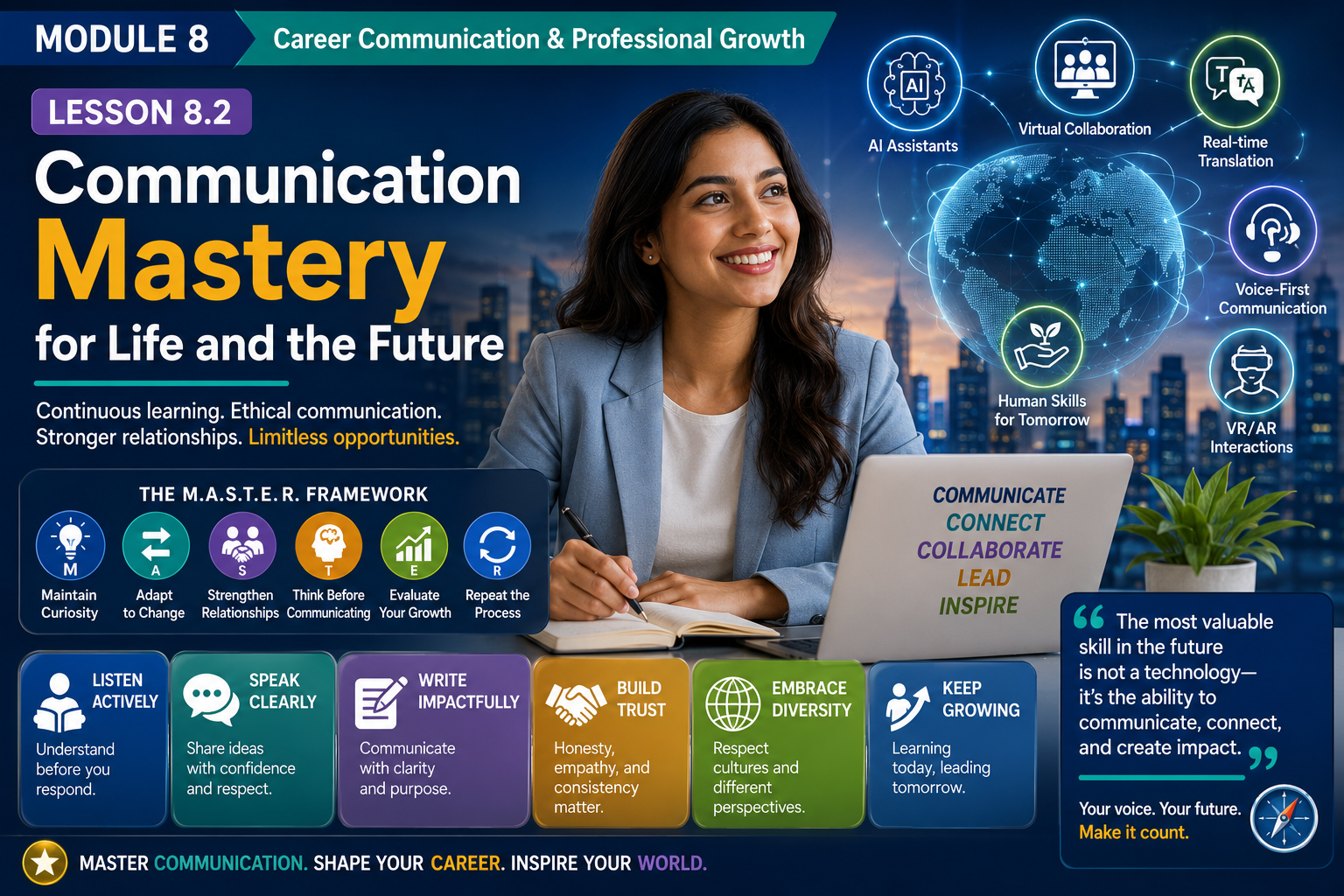
Communication is more than a workplace skill—it is a lifelong capability that shapes careers, relationships, leadership, learning, and personal success. As technology continues to evolve through artificial intelligence (AI), automation, virtual reality (VR), augmented reality (AR), and global digital collaboration, communication itself is changing.
The future belongs to professionals who can combine technical knowledge with emotional intelligence, ethical leadership, adaptability, critical thinking, and effective communication. This lesson brings together everything you have learned throughout the course and prepares you to become a confident communicator in the AI-powered future.
Rather than viewing communication as a skill to master once, successful professionals treat it as a lifelong journey of continuous learning and improvement.
Learning Objectives
By the end of this lesson, you will be able to:
- Understand the future of communication in the AI era.
- Develop lifelong communication habits.
- Build a personal communication improvement plan.
- Communicate ethically and responsibly.
- Adapt to emerging communication technologies.
- Become a confident lifelong learner and communicator.
1. The Future of Communication
Communication has evolved rapidly.
From:
- Face-to-face conversations
to
- Video conferencing
- Social media
- AI assistants
- Virtual collaboration
- Global digital workplaces
The next generation of communication will include:
- AI copilots
- Real-time translation
- Virtual Reality meetings
- Augmented Reality collaboration
- Intelligent knowledge assistants
- Digital avatars
- Voice-first interfaces
Technology will continue changing.
Human communication will remain essential.
Future Workplace Skills
Future professionals will need the following:
- Communication
- Critical thinking
- Creativity
- Emotional intelligence
- Adaptability
- Collaboration
- Ethical decision-making
- Digital literacy
These human skills cannot be fully automated.
2. Lifelong Learning Mindset
Communication is not learned in a single course.
It improves through:
- Practice
- Reflection
- Feedback
- Observation
- Curiosity
- Continuous learning
The world’s best communicators continue learning throughout their careers.
Daily Improvement Habits
Spend a few minutes each day:
- Reading
- Listening actively
- Practicing conversations
- Learning new vocabulary
- Watching skilled speakers
- Reflecting on your communication
Small improvements create long-term success.
3. Ethical Communication
Trust is the foundation of effective communication.
Professional communicators always strive to be the following:
- Honest
- Respectful
- Accurate
- Transparent
- Responsible
- Inclusive
Integrity creates lasting influence.
Digital Ethics
In the digital world:
Always:
- Verify information.
- Respect privacy.
- Credit original sources.
- Avoid misinformation.
- Protect confidential data.
- Communicate respectfully online.
Responsible communication strengthens credibility.
4. Communicating with AI
Artificial intelligence has become a communication partner.
AI can help with:
- Writing
- Translation
- Brainstorming
- Research
- Meeting summaries
- Presentation preparation
- Learning support
However,
AI cannot replace:
- Human empathy
- Ethics
- Creativity
- Leadership
- Emotional understanding
Use AI to enhance—not replace—your communication.
Best Practices
Always:
- Verify AI-generated information.
- Protect confidential information.
- Edit AI-generated content.
- Maintain your authentic voice.
- Apply human judgment.
Technology works best when guided by people.
5. Building Your Personal Communication System
High-performing professionals develop communication habits.
Create systems rather than relying on motivation.
Weekly Communication Review
Ask yourself:
- Did I listen actively?
- Did I communicate respectfully?
- Did I write clearly?
- Did I improve one communication skill?
- Did I learn from feedback?
Continuous reflection accelerates growth.
6. Communication in Leadership
Future leaders communicate by:
- Inspiring others.
- Solving problems.
- Building trust.
- Managing change.
- Encouraging collaboration.
- Supporting innovation.
Leadership begins with communication.
Leadership Habits
Great leaders:
- Listen first.
- Speak clearly.
- Admit mistakes.
- Encourage ideas.
- Recognize achievements.
- Respect differences.
Leadership is built through daily communication.
7. Personal Growth Through Communication
Communication strengthens every area of life.
It improves:
- Careers
- Friendships
- Family relationships
- Business
- Education
- Community involvement
- Leadership
- Self-confidence
Every conversation becomes an opportunity to grow.
8. Becoming a Global Citizen
Modern professionals communicate across cultures every day.
Successful global communicators demonstrate the following:
- Curiosity
- Respect
- Adaptability
- Inclusion
- Empathy
- Cultural awareness
Learning never stops.
9. Designing Your Communication Growth Plan
Long-term improvement requires clear goals.
Example Plan
Daily
- Practice active listening.
- Read for 20 minutes.
- Learn one new word.
- Reflect on one conversation.
Weekly
- Deliver a short presentation.
- Request feedback.
- Improve one writing skill.
- Network with one new professional.
Monthly
- Complete a communication course.
- Read one communication book.
- Practice public speaking.
- Review personal progress.
Consistency produces mastery.
10. Your Communication Legacy
At the end of your career,
People may not remember:
- Every email.
- Every meeting.
- Every presentation.
They will remember:
- How you treated people.
- How you solved problems.
- How you inspired others.
- How you built trust.
- How you communicated during difficult times.
Communication becomes part of your legacy.
The M.A.S.T.E.R. Framework
Use the M.A.S.T.E.R. Framework as your lifelong guide.
M — Maintain Curiosity
Always keep learning.
↓
A — Adapt to Change
Embrace new technologies and communication methods.
↓
S — Strengthen Relationships
Build trust through respect and empathy.
↓
T — Think Before Communicating
Choose words carefully and ethically.
↓
E — Evaluate Your Growth
Reflect regularly and seek feedback.
↓
R — Repeat the Process
Continuous improvement leads to mastery.
Real-World Scenario
Sophia begins her career as a junior marketing professional.
She commits to improving one communication skill every month. She joins a public speaking club, practices active listening during meetings, uses AI to improve her writing while reviewing every draft, reads books on leadership, and requests feedback from her manager.
Over five years, she becomes known not only for her technical expertise but also for her ability to explain complex ideas clearly, resolve conflicts professionally, inspire colleagues, and lead international projects.
Her career growth is driven by continuous communication improvement rather than talent alone.
Communication Mastery Blueprint
Develop Self-Awareness
↓
Practice Every Day
↓
Seek Feedback
↓
Learn Continuously
↓
Communicate Ethically
↓
Use AI Responsibly
↓
Build Strong Relationships
↓
Lead with Confidence
↓
Continue Growing Throughout Life
Course Summary
Throughout this course, you have learned to:
- Understand the foundations of modern communication.
- Build confidence and develop a positive communication mindset.
- Improve verbal and nonverbal communication.
- Master active listening.
- Write professional emails and business messages.
- Deliver effective presentations and public speeches.
- Communicate across cultures.
- Resolve conflicts professionally.
- Build your career through networking and personal branding.
- Prepare for the future of communication in the AI era.
These skills are valuable in every profession and every stage of life.
Key Takeaways
- Communication is a lifelong skill that continues to evolve.
- Human qualities such as empathy, ethics, creativity, and critical thinking remain essential in the AI era.
- Lifelong learning and consistent practice are the foundations of communication mastery.
- Ethical communication builds trust and credibility.
- AI should enhance—not replace—human communication.
- Leadership begins with listening, understanding, and inspiring others.
- Small daily improvements create significant long-term results.
- The M.A.S.T.E.R. Framework provides a roadmap for lifelong communication excellence.
- Your communication habits shape your professional reputation and personal legacy.
- Mastering communication empowers you to succeed in a rapidly changing global world.
Final Course Activity – Your 90-Day Communication Mastery Challenge
Create your own 90-day communication improvement plan using the M.A.S.T.E.R. Framework.
Include:
Daily Goals
- Practice active listening.
- Read for at least 20 minutes.
- Learn one new communication concept or vocabulary word.
- Reflect on one conversation.
Weekly Goals
- Deliver a short presentation or explain a topic to someone.
- Write one professional email or article with extra attention to clarity.
- Request feedback from a colleague, mentor, or friend.
- Connect with one new professional online or offline.
Monthly Goals
- Complete one communication-related course, webinar, or book.
- Practice public speaking or storytelling.
- Review your communication strengths and areas for improvement.
- Update your personal development journal with lessons learned.
At the end of the 90 days, evaluate your progress by asking:
- Have I become a better listener?
- Do I communicate with greater confidence and clarity?
- Have I improved my professional relationships?
- Am I using AI responsibly while maintaining my authentic voice?
- What communication goal will I pursue next?
Final Message
Communication is not just a skill—it is a lifelong advantage.
The professionals who thrive in the future will not necessarily be those with the highest technical expertise but those who can communicate ideas clearly, build trust, adapt to change, collaborate across cultures, and lead with empathy and integrity.
Every conversation is an opportunity to learn.
Every message is an opportunity to create value.
Every interaction is an opportunity to leave a positive impact.
Keep learning. Keep communicating. Keep growing.